Meta Description: Discover the best knife sharpeners of 2026, from electric and manual models to precision systems. Compare features, prices, pros, cons, and top picks.
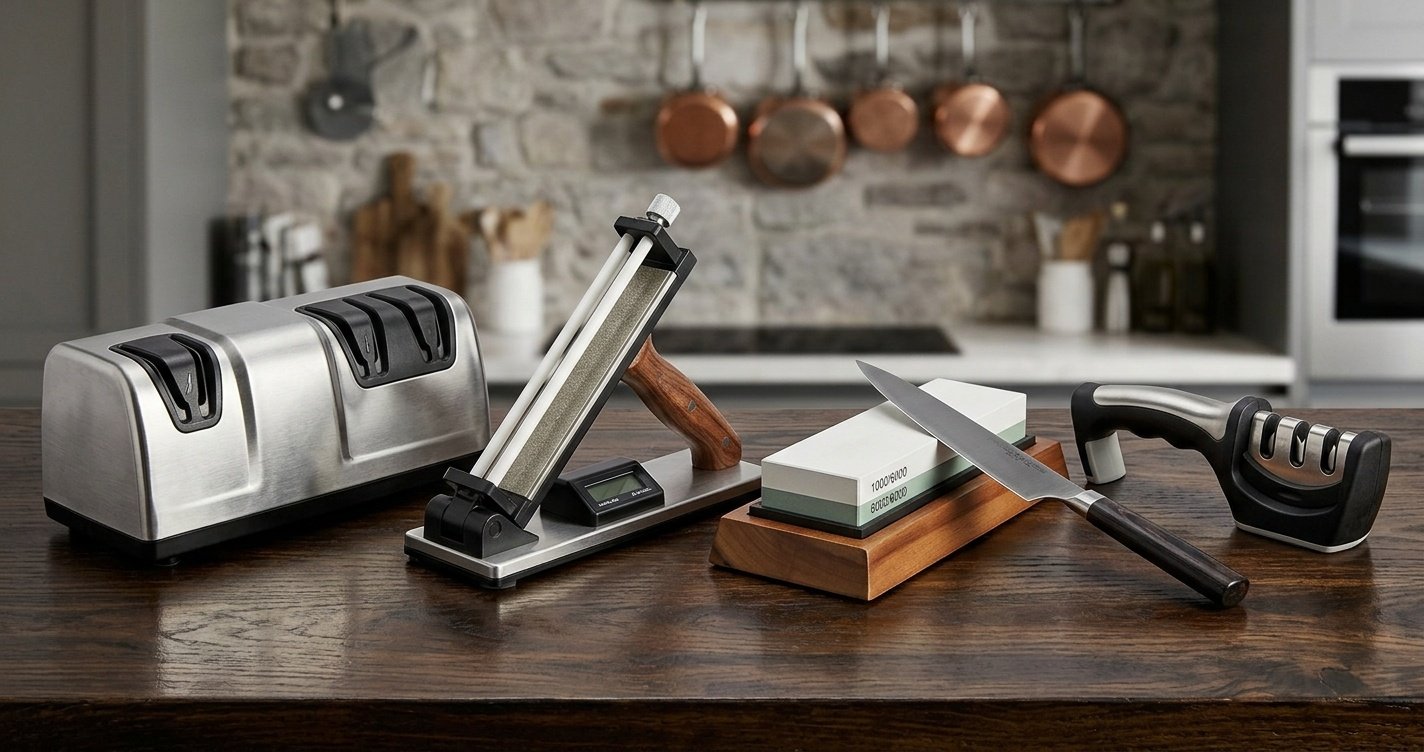
A dull knife is frustrating, inefficient, and can actually be harder to control than a sharp one. The good news is that you don’t need professional sharpening equipment—or professional sharpening skills—to restore a useful edge at home.
But choosing the best knife sharpener in 2026 isn’t as simple as picking the model with the highest rating. Electric sharpeners are fast and convenient, guided systems offer more control, and premium machines can produce highly consistent edges while removing relatively little metal.
We compared the leading options based on sharpening performance, ease of use, angle control, knife compatibility, speed, build quality, and value. Current 2026 testing also puts the Chef’sChoice 15XV among the strongest electric options, while Work Sharp and Tormek offer compelling alternatives for shoppers who want more control or a premium sharpening experience.
Read More: How to Clean a Smelly Dishwasher
Table of contents
Best Knife Sharpeners 2026 — Quick Comparison
| Sharpener | Best for | Type | Approx. price* |
| Chef’sChoice 15XV Trizor XV | Best overall | Electric | ~$137–$160 |
| Work Sharp Precision Adjust | Best guided sharpener | Manual guided | ~$88 |
| Work Sharp Professional Precision Adjust | Best for enthusiasts | Manual guided | ~$300 |
| Tormek T-1 | Best premium kitchen sharpener | Powered diamond wheel | ~$428 |
| Chef’sChoice 4643 | Best manual option | Pull-through manual | ~$50–$60 |
*Prices fluctuate by retailer, promotions, and region.
1. Chef’sChoice 15XV Trizor XV — Best Overall
For most home cooks who want fast, repeatable sharpening without learning freehand technique, the Chef’sChoice 15XV is the easiest recommendation.
The three-stage electric system is designed around a 15-degree edge and handles sharpening, honing, and polishing. Consumer Reports testing reported that it consistently produced a precise edge across different knives, while the manufacturer says it can also handle serrated and single-sided knives.
Why we like it:
- Very little technique required
- Fast compared with manual sharpening
- Three-stage sharpening and polishing
- Works with many kitchen-knife styles
- Particularly attractive for busy home cooks
Best for: Someone who wants excellent results with minimal effort.
2. Work Sharp Precision Adjust — Best Value for Precision
If you want more control than an electric pull-through sharpener provides, the Work Sharp Precision Adjust is one of the most compelling choices.
Its guided system lets you select an angle between 15 and 30 degrees, while a V-block clamp holds the knife in position. The included Tri-Brasive handle combines 320- and 600-grit diamond abrasives with fine ceramic sharpening. Work Sharp currently lists it at $87.95.
Pros:
- Adjustable 15–30° sharpening angle
- Guided sharpening reduces technique errors
- Diamond and ceramic abrasives included
- Compact compared with powered machines
- Excellent price-to-control ratio
Cons:
- Slower than an electric sharpener
- Requires more involvement from the user
- Not as comprehensive as the Professional model
Best for: Home cooks, hobbyists, and knife owners who want to learn proper sharpening without spending hundreds of dollars.
3. Work Sharp Professional Precision Adjust — Best for Enthusiasts
For serious knife enthusiasts, the Work Sharp Professional Precision Adjust takes the guided-system concept considerably further.
It has continuous angle adjustment from 15° to 30°, a digital angle indicator, a weighted base, a metal V-block clamp, multiple diamond abrasives, ceramic sharpening, and a leather strop. Work Sharp lists the system at $299.95 and backs it with a three-year
The digital inclinometer is particularly useful when you’re trying to reproduce the same edge angle across multiple sharpening sessions.
Pros:
- Extremely precise angle adjustment
- Rigid metal construction
- Broad abrasive selection
- Excellent repeatability
- Suitable for kitchen, pocket, and outdoor knives
Cons:
- Expensive
- Larger learning curve than a pull-through sharpener
- Overkill for someone who only occasionally sharpens kitchen knives
Best for: Knife enthusiasts who care about edge geometry and repeatability.
4. Tormek T-1 Kitchen Knife Sharpener — Best Premium Kitchen Sharpener
The Tormek T-1 takes a different approach. Instead of pulling a knife through abrasive slots, it uses a fine-grit diamond grinding wheel followed by a composite honing wheel.
Its patented guide helps establish a consistent sharpening angle, and Tormek says the machine removes minimal material while sharpening the entire bevel. It operates at approximately 45 dB and comes with an eight-year warranty when the additional warranty period is registered.
The T-1 is specifically designed for kitchen knives rather than being a universal knife-sharpening platform.
Pros:
- Premium construction
- Precise guided sharpening
- Diamond grinding wheel
- Integrated honing stage
- Relatively quiet operation
- Designed to minimize unnecessary steel removal
Cons:
- Expensive
- Larger than a conventional pull-through sharpener
- Kitchen-focused rather than a general-purpose pocket-knife system
Best for: Serious home cooks who want a premium, dedicated kitchen sharpening machine.
5. Chef’sChoice 4643 — Best Manual Sharpener
If you don’t want an electric machine, the Chef’sChoice 4643 is worth considering.
It supports both 15- and 20-degree knife edges and uses diamond abrasives. That makes it more versatile than a basic fixed-angle manual sharpener, particularly for households with both Asian-style and Western-style knives. Current 2026 testing from Consumer Reports ranked it highly among manual sharpeners.
The tradeoff is that independent testing has produced less enthusiastic results than the Consumer Reports assessment, with one 2025 test finding it relatively slow and less sharp than expected for its price.
Pros:
- No electricity required
- 15° and 20° settings
- Compact
- Diamond abrasives
- Suitable for many straight and serrated knives
Cons:
- Technique still matters
- Slower than electric alternatives
- Independent testing has raised concerns about ultimate sharpness
Best for: Shoppers who want a compact manual sharpener with multiple angle options.
Electric vs. Manual vs. Guided Sharpeners
The “best” sharpener depends heavily on how much control you want.
Electric sharpeners
Choose electric if:
You want the fastest and simplest solution.
Electric models such as the Chef’sChoice 15XV are particularly appealing when several people in the household use the same knives. You don’t need to develop much sharpening technique, and the machine controls the angle for you.
Manual pull-through sharpeners
Choose manual if: Price, simplicity, and storage space matter most.
They’re compact and inexpensive, but you generally have less control over the edge than with a guided sharpening system.
Guided sharpeners
Choose guided if: You want precision without becoming a freehand sharpening expert.
The Work Sharp Precision Adjust is a good example: you select the angle, and the system helps maintain it throughout sharpening.
Premium sharpening machines
Choose premium equipment if: You own expensive knives and want consistent, repeatable results.
The Tormek T-1 is particularly attractive for dedicated home cooks because it is purpose-built for kitchen knives and combines grinding and honing in one machine.
What to Look for When Buying a Knife Sharpener
1. Sharpening angle
Angle is one of the most important specifications.
Many Western-style kitchen knives traditionally use a relatively robust edge around 20 degrees per side, while many Japanese-style knives use narrower angles around 15 degrees. A sharpener that accommodates multiple angles is therefore more versatile.
2. Abrasive type
Diamond abrasives are aggressive and effective for reshaping an edge. Ceramic is generally useful for finer finishing and honing.
For badly damaged knives, having a coarse abrasive is particularly useful.
3. Angle consistency
A theoretically excellent sharpening angle doesn’t help much if you can’t reproduce it.
Guided systems solve this problem by physically controlling the angle, while electric and pull-through machines build the angle into the sharpening mechanism.
4. Material removal
A sharpener shouldn’t remove more steel than necessary.
This is especially important with expensive knives. Premium systems such as the Tormek T-1 emphasize minimal material removal during sharpening.
5. Knife compatibility
Before buying, check whether the sharpener works with:
- Straight-edge chef’s knives
- Serrated knives
- Japanese knives
- Single-bevel knives
- Pocket knives
- Thick blades
- Ceramic knives
Don’t assume that a sharpener designed for kitchen knives will automatically be suitable for every blade you own. For example, Tormek explicitly describes the T-1 as a kitchen-knife sharpener, while its commercial T-2 is intended for professional kitchens.
Which Knife Sharpener Should You Buy?
For the majority of people, our recommendations are straightforward:
- Best overall: Chef’sChoice 15XV
- Best value for precision: Work Sharp Precision Adjust
- Best for serious enthusiasts: Work Sharp Professional Precision Adjust
- Best premium kitchen option: Tormek T-1
- Best manual: Chef’sChoice 4643
If you simply want your kitchen knives sharp again with minimal fuss, buy an electric model such as the Chef’sChoice 15XV.
If you’re willing to spend a little more time learning the process and want greater control over your knives’ edges, the Work Sharp Precision Adjust is the better long-term choice.
And if you have an expensive knife collection and don’t mind paying for premium equipment, the Tormek T-1 or Work Sharp Professional Precision Adjust makes more sense.
Final Verdict
The best knife sharpener isn’t necessarily the most expensive one. It’s the model that gives you the right combination of edge quality, consistency, convenience, and control for the knives you actually own.
For a typical kitchen, the Chef’sChoice 15XV offers the easiest path to consistently sharp knives. The Work Sharp Precision Adjust is our pick for shoppers who want more sharpening control without entering premium-machine territory. And for enthusiasts prepared to invest, the Work Sharp Professional Precision Adjust and Tormek T-1 offer substantially more sophisticated sharpening systems.
Before purchasing, check the required sharpening angle and knife compatibility first. Those two specifications can matter more than price or the number of sharpening stages.
FAQ
Are electric knife sharpeners worth it?
Yes, particularly if convenience is your priority. They remove much of the technique required to maintain a consistent angle.
Is a 15-degree or 20-degree sharpener better?
Neither is universally better. The appropriate angle depends on the knife’s intended edge geometry. A multi-angle sharpener offers greater flexibility.
Can a knife sharpener ruin a knife?
An inappropriate technique or overly aggressive sharpening can remove unnecessary material or damage an edge. For expensive knives, a guided system can make consistent sharpening easier.
How often should you sharpen kitchen knives?
It depends on usage, steel, cutting surface, and how demanding you are about sharpness. Light maintenance may be needed regularly, while actual edge sharpening can be much less frequent.
What is better: a whetstone or a knife sharpener?
A whetstone gives an experienced user exceptional control, but it has a steeper learning curve. Guided and electric sharpeners are generally better choices for beginners who prioritize convenience and repeatability.