Table of contents
Best Non-Toxic Cookware for Health-Conscious Families
The safest non-toxic cookware for families is 100% PFAS-free stainless steel, pure ceramic, or well-seasoned cast iron — all of which don’t leach chemicals into food even at high heat. Avoid cookware with scratched non-stick coatings, unsealed aluminum, or coatings that don’t disclose their materials.
Choosing cookware isn’t just a kitchen decision — it’s a health decision. With growing awareness of PFAS (“forever chemicals”), heavy metal leaching, and coating breakdown at high heat, more families are rethinking what’s in their pots and pans. This guide breaks down exactly what “non-toxic” means, which materials actually hold up, and how to shop with confidence.
Read More: 7 Best Cookware Sets in 2026 (Tested & Compared)
What Makes Cookware “Non-Toxic”?
Non-toxic cookware is free of PFAS (including PTFE/Teflon), lead, and cadmium — materials that can leach into food or release fumes when coatings overheat or break down.
PFAS is a class of over 14,000 synthetic chemicals used in nonstick coatings since the 1950s. According to the National Institute of Environmental Health Sciences, PFAS exposure has been linked to hormone disruption, immune suppression, and certain cancers, which is why families are increasingly steering away from coated pans altogether.
Is “PFOA-Free” the Same as Non-Toxic?
No. “PFOA-free” is a marketing claim that means almost nothing today, since PFOA was already phased out of most US cookware two decades ago — the label doesn’t guarantee the pan is free of other PFAS chemicals like PTFE.
Look specifically for “PFAS-free” or “PTFE-free” labeling, ideally backed by third-party testing rather than a brand’s own claim. The EPA formally designated PFOA and PFOS as hazardous substances in 2024, a category reserved for chemicals linked to cancer, genetic mutation, or reproductive harm — a sign of how seriously regulators now treat this chemical family.
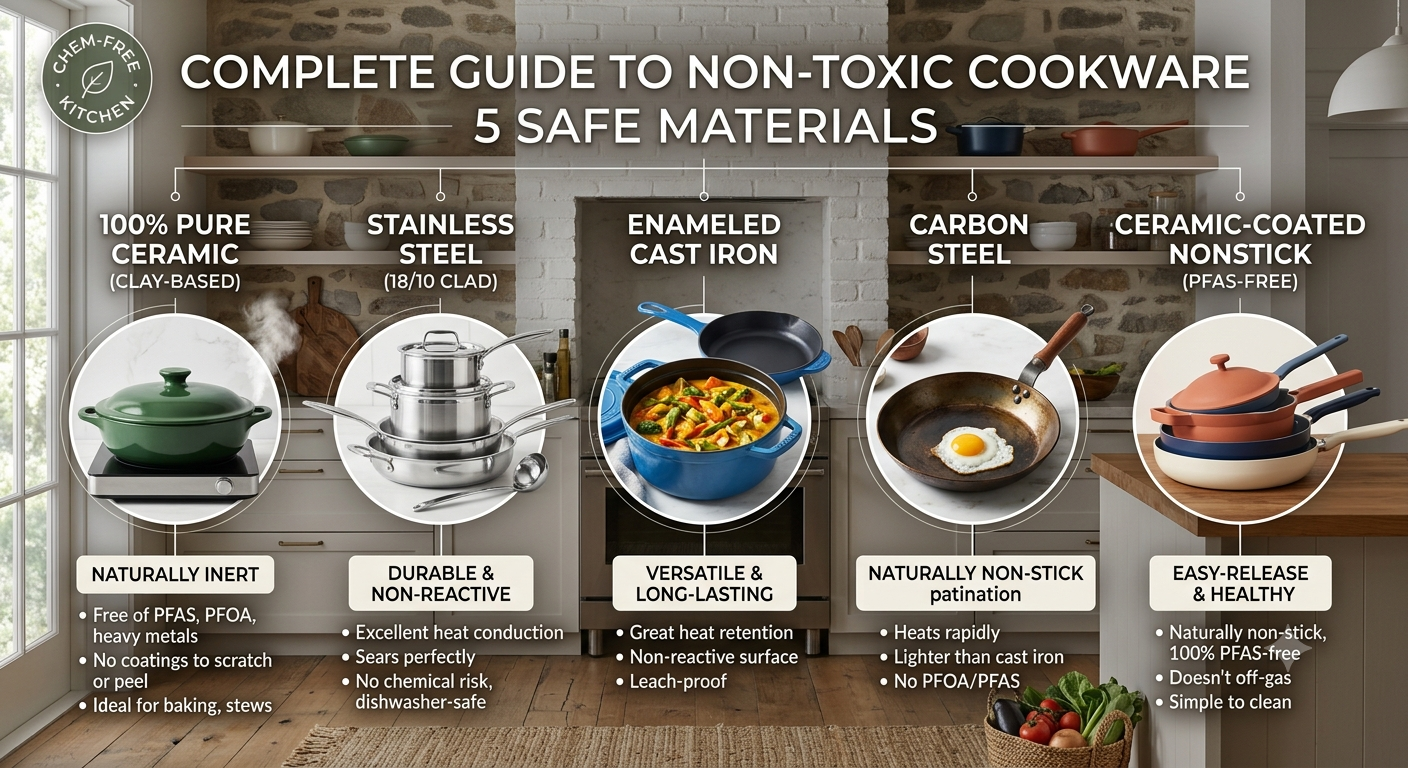
Cookware Materials Compared
| Material | Non-Toxic Rating | Best For | Watch Out For |
|---|---|---|---|
| Stainless Steel | Excellent | Searing, sauces, everyday cooking | Food can stick without enough oil |
| Cast Iron | Excellent (when seasoned) | High-heat searing, baking | Heavy; needs seasoning maintenance |
| Pure Ceramic | Very Good | Low-to-medium heat cooking | Can chip if dropped |
| Ceramic-Coated | Good (varies by brand) | Easy-release cooking | Coating wears down over 1–3 years |
| Enameled Cast Iron | Excellent | Braising, soups, stews | Heavier, higher price point |
| Traditional Non-Stick (PTFE) | Caution | Delicate foods like eggs | Coating breakdown at high heat |
| Uncoated Aluminum | Caution | Not recommended for daily use | Can leach with acidic foods |
What’s the Safest Cookware Material for Kids’ Meals?
Stainless steel and cast iron are the safest choices for cooking food that kids will eat, since neither relies on a coating that can scratch, flake, or degrade over time.
Uncoated metal cookware removes the coating question entirely — there’s no synthetic layer to wear off into food, no risk of overheating fumes, and no ambiguity about what the cooking surface actually is. The tradeoff is a steeper learning curve for avoiding sticking compared to non-stick pans.
Is Ceramic Cookware Good for Families?
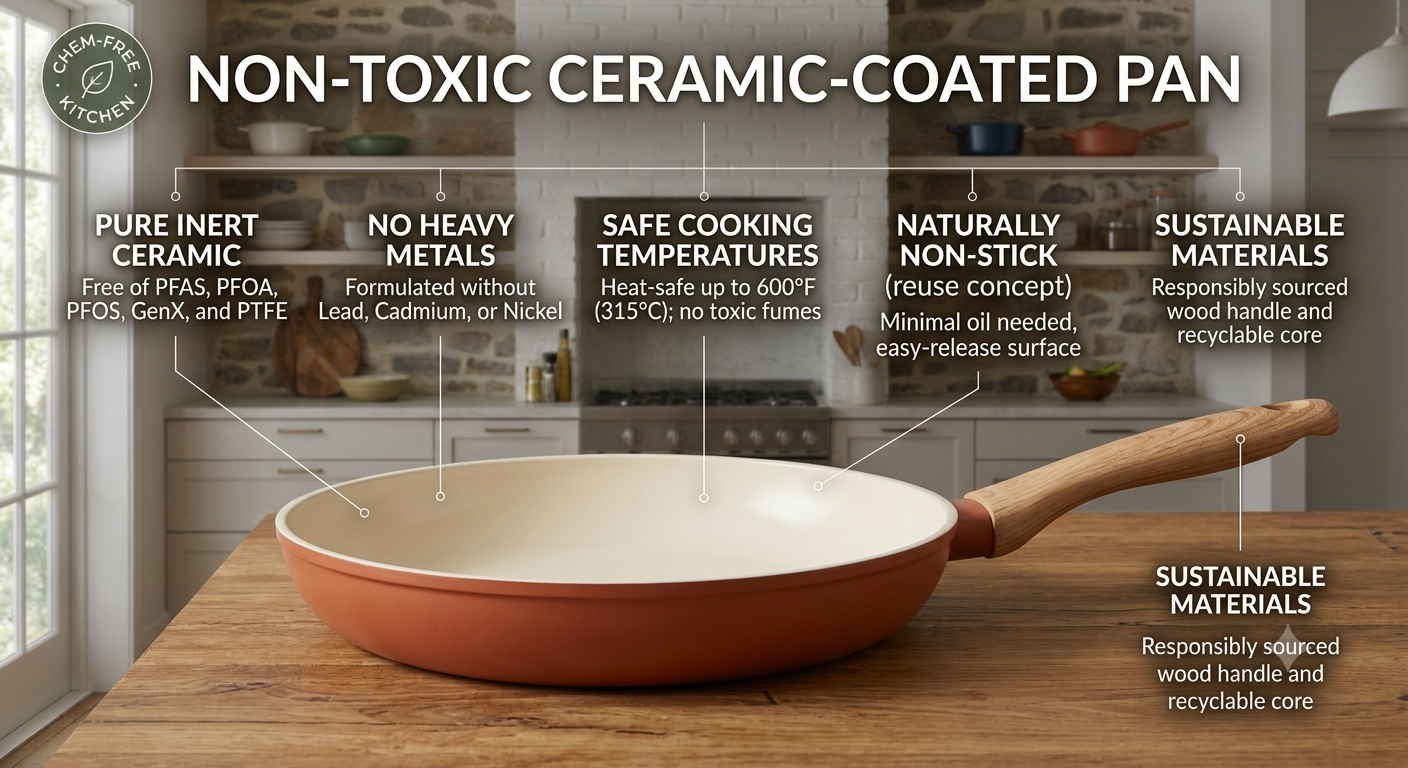
Yes, PFAS-free ceramic cookware is a solid family option for easy weekday cooking (eggs, pancakes, fish), but it wears out faster than uncoated metal, typically needing replacement every 3–5 years.
Ceramic gives families the convenience of a non-stick surface without PTFE, which matters for busy households cooking daily. The key is buying from brands with verified, tested PFAS-free coatings rather than trusting the word “ceramic” alone, since that term isn’t legally regulated and quality varies widely between brands.
Should Families Avoid All Non-Stick Cookware?
Not necessarily — a family doesn’t need to eliminate every non-stick pan, but should avoid old, scratched, or unlabeled non-stick cookware and prioritize verified PFAS-free options going forward.
A single well-maintained, PFAS-free ceramic pan reserved for eggs or fish is a reasonable middle ground for most households. The bigger risk comes from older, damaged PTFE pans still in circulation, since a scratched or overheated coating is when the actual health concerns kick in.
Are State PFAS Bans Affecting What’s Available?
Yes — several US states have started phasing out PFAS cookware, which is accelerating the shift toward non-toxic materials across major retailers.
Connecticut requires PFAS cookware to carry a warning label starting July 1, 2026, with a full sales ban by January 1, 2028, and Vermont’s ban follows in 2028. Major retailers have also begun phasing out PFAS-containing products ahead of these deadlines, so non-toxic options are becoming easier — not harder — to find.
People Also Ask
What cookware should I throw away immediately?
Any non-stick pan with visible flaking, peeling, or deep scratches should be replaced right away, since damaged coatings are the main source of both fume risk and particles getting into food.
Is stainless steel cookware really PFAS-free?
Yes — stainless steel has no non-stick coating at all, so it carries zero PFAS risk regardless of brand or price point.
Is enameled cast iron safe for daily family cooking?
Yes, enameled cast iron is considered one of the safest options for daily use since the enamel coating is glass-based, not a synthetic polymer, and doesn’t react with acidic foods.
Do glass and ceramic bakeware need the same scrutiny as cookware pans?
Less so — plain glass and lead-free ceramic bakeware are generally inert and don’t involve the same coating concerns as stovetop non-stick pans, though older or imported ceramic dishware should still be checked for lead.
Is it worth replacing all cookware at once for a family?
Not necessarily — many families phase in non-toxic cookware gradually, starting with whichever pans are oldest, most scratched, or used most often for children’s meals.
Conclusion
For health-conscious families, the safest strategy isn’t chasing a single “best” pan — it’s building a kitchen around uncoated metal for daily workhorse cooking, with one or two verified PFAS-free ceramic pans for convenience. Stainless steel and cast iron remove the coating question entirely, while a well-chosen ceramic pan covers the eggs-and-pancakes gap without PTFE.
What matters most is reading past the marketing: “PFOA-free” isn’t the same as “PFAS-free,” and “ceramic” isn’t a regulated term. Look for explicit PFAS-free or PTFE-free labeling backed by third-party testing, and replace scratched or aging non-stick pans sooner rather than later.