According to Bosch’s own official support page, the fix for E01 is straightforward as a first step: reset power at the circuit breaker for 30 seconds, and if the code returns, contact Bosch Customer Support. What E01 actually means varies more than you’d expect depending on your dishwasher’s series and generation — it’s documented as everything from a general control board communication fault, to a heating element or water temperature issue, to (on 800 Series and Benchmark models specifically) a failed PerfectDry zeolite drying motor. Because the cause differs by model, if E01 keeps coming back after a reset, it’s worth matching your specific model number to the causes below rather than assuming it’s one fixed problem.
Read More: Best Kitchen Knife Sets of 2026, Tested & Reviewed
Table of contents
Why Is My Bosch Dishwasher Showing an E01 Error?
This is worth addressing directly, because independent repair sources genuinely describe E01 differently — and that disagreement isn’t a mistake; it reflects real differences between Bosch model generations and series. Here’s what’s actually documented:
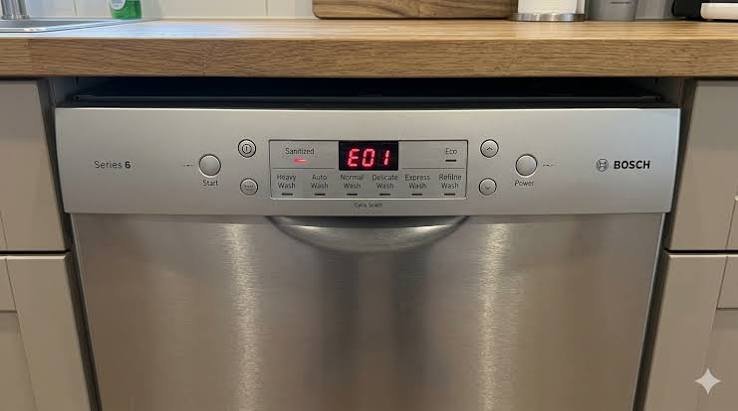
- “Is it a general electronics problem?” Some technician-facing sources describe E01 broadly as the control board detecting an abnormal electrical or signal condition somewhere in its circuitry — an early-warning safety measure rather than one specific failed part.
- “Is my water not heating up right?” Other detailed diagnostic guides describe E01 as the control board detecting that water hasn’t reached its programmed temperature within the expected time, monitored via an NTC (Negative Temperature Coefficient) sensor. The cycle may pause or finish with cold water, leaving dishes greasy or streaky.
- “Why is this only happening on my 800 Series or Benchmark model?” On dishwashers using Bosch’s Zeolith drying system, some specialists report E01 appearing almost exclusively on these premium models when the brushless motor that circulates air through the zeolite drying container fails, stalls, or loses its speed-feedback signal.
- “Could hard water have burned out a part?” Another source attributes E01 to burnt contacts or a burnt heating element itself, often caused by calcification from hard water buildup over time.
- “Is it my water supply or the door not closing right?” At least one appliance-forum diagnosis links E01 to a water supply problem or a faulty door latch mechanism instead.
The practical takeaway: don’t assume you know what’s wrong just from seeing the code. Check it against your exact model number, and treat the explanations above as “things to check,” not a single confirmed diagnosis.
How Do I Fix the E01 Error on My Bosch Dishwasher?
Step 1: “Can I fix this myself without calling anyone?” — Try a Power Reset First
This is Bosch’s own recommended first step and clears a meaningful share of E01 occurrences on its own, regardless of which underlying cause applies to your model:
- Turn off power to the dishwasher at the circuit breaker — not just the door switch.
- Wait a full 30 seconds. Some technicians recommend extending this to 5–10 minutes for a more thorough reset of the control board.
- Restore power and run a normal cycle to see if the code has cleared.
If E01 disappears and doesn’t come back, it was likely a one-time electronic glitch. If it returns, move to the model-specific checks below.
Step 2: “What do I check next if the reset didn’t work?”
“Does my dishwasher have PerfectDry or zeolite drying (800 Series, Benchmark)?”
Check whether dishes are coming out wet rather than showing wash problems — that points toward the heat pump motor explanation. It’s safe to keep running the dishwasher in this state, since E01 here is a drying-system fault, not an electrical or water hazard; you’ll simply get wet dishes at the end of each cycle. That said, the motor sits behind the inner door panel next to live electronics and has no owner-serviceable parts, so a persistent code on these models generally means calling a technician rather than attempting a DIY repair.
“Why do my dishes look greasy or streaky after a cycle?”
That’s a sign worth checking against the heating/temperature explanation. If you have a multimeter, testing the thermistor’s resistance can help confirm this — set it to ohms, and a reading of “OL” means the thermistor needs replacing. Running the dishwasher with this fault won’t cause further damage, but wash quality will suffer and high-temperature sanitizing won’t function correctly.
“Could my hard water be the reason?”
Check whether your home has notably hard water and whether the dishwasher has gone a long time without descaling. In Bosch dishwashers, the heating element is often a one-piece unit with slots for hoses and nozzles rather than something that disassembles for repair — if it’s burnt through calcification, the entire unit typically needs replacing rather than being serviceable in parts.
“Is it possible this is just a water inlet or door issue?”
Check the water inlet valve for blockages or unusually low water pressure, and confirm the door latches fully and clicks into place. Some users have reported clearing an E01 code simply by running the hot water tap at the sink briefly before starting the dishwasher, which suggests the issue was related to cold water entering the fill cycle rather than a hardware failure.
Is It Safe to Keep Using My Dishwasher If It Shows E01?
This depends on which underlying cause applies, and sources genuinely disagree here too:
- If it’s a drying-system fault (PerfectDry/zeolite motor), it’s generally considered safe to keep washing — you’ll just get wet dishes, and running it this way won’t cause further damage.
- If it’s a heating/temperature fault, running it repeatedly won’t cause further damage either, but wash quality and sanitization will be compromised.
- If it points to a broader control board or electrical fault, at least one source recommends against continued use, citing risk of worsening damage or a potential safety issue.
Given this uncertainty, the safest approach is to stop using the dishwasher if E01 persists after a power reset, until you’ve either identified which specific cause applies to your model or had a technician confirm it’s safe to continue.
When Should I Just Call a Technician for E01?
Call Bosch Customer Support or a certified technician if:
- E01 comes back after you’ve already tried a power reset at the breaker.
- You notice signs of electrical damage, burning smells, or the dishwasher tripping a breaker.
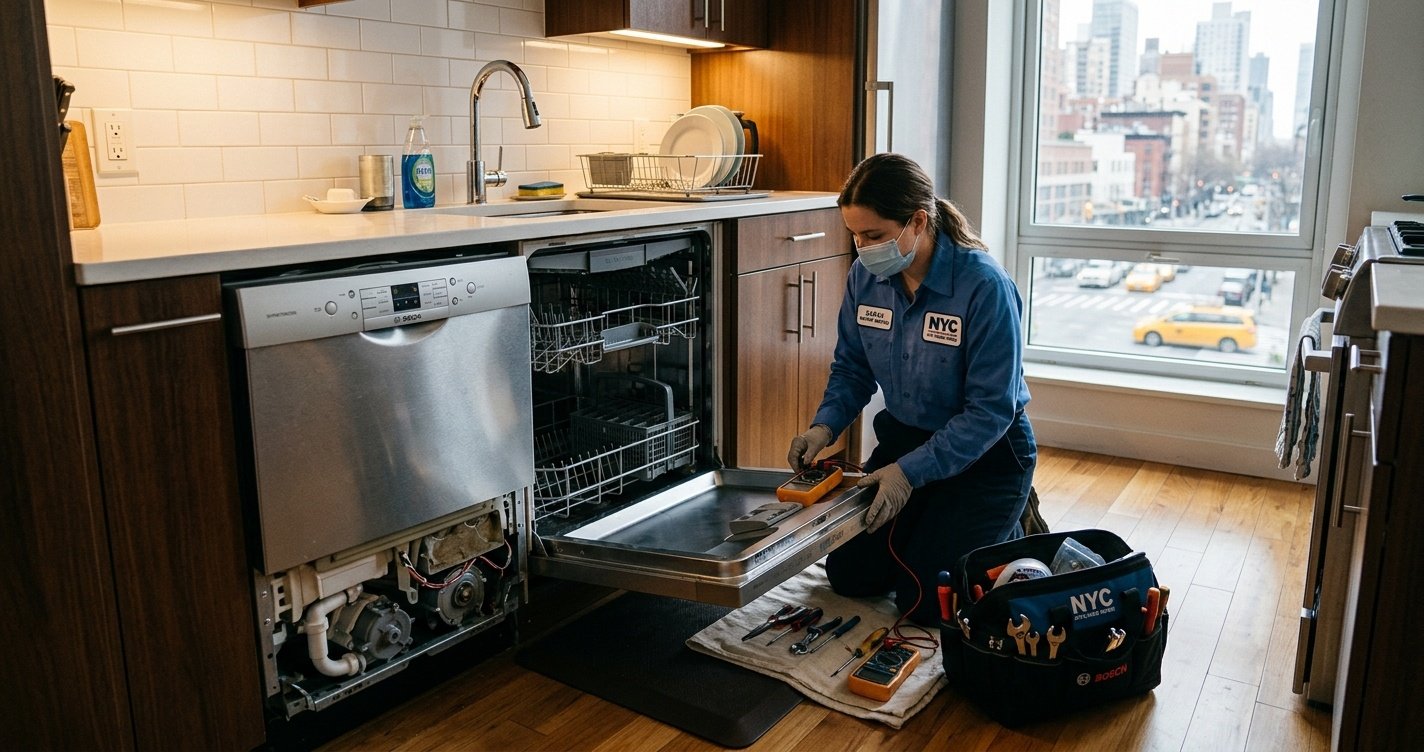
- Your model uses PerfectDry/zeolite drying and the heat pump motor is suspected — this part has no owner-serviceable components.
- You’ve checked the model-appropriate causes above (heating element, water inlet, door latch) and the code still won’t clear.
Bosch’s own support line is 1-800-944-2904 (US). Have your dishwasher’s exact model number ready before calling, since the correct diagnosis and parts depend heavily on which model and series you own.
Frequently Asked Questions
Why does my Bosch dishwasher say E01?
It depends on your model — documented explanations range from a general control board communication fault, to a heating or water-temperature issue, to a failed PerfectDry drying motor on 800 Series and Benchmark models specifically. Check the cause against your exact model rather than assuming one fixed meaning.
How do I clear an E01 error on my Bosch dishwasher?
Start with Bosch’s own recommended fix: reset power at the circuit breaker for 30 seconds — some technicians suggest up to 5–10 minutes — then restart the dishwasher. If the code comes back, the cause is likely model-specific and may need a technician.
Can I keep using my dishwasher if it shows E01?
It depends on the underlying cause, and sources disagree — some describe E01 as a drying-only fault that’s safe to keep washing through, while others describe it as an electrical fault that shouldn’t be ignored. If you’re not sure which applies to your model, it’s safest to stop use until confirmed.
Can hard water cause my dishwasher to show E01?
Yes, according to at least one source — calcification from hard water can burn out the heating element’s contacts over time, triggering E01. Regular descaling can help prevent this on models where it applies.
Do I have to call a technician every time I see E01?
Not always. A one-time electronic glitch often clears with a simple power reset. A persistent E01, especially on models with PerfectDry/zeolite drying, typically points to a component with no owner-serviceable parts, which does need a technician.
Could a power outage or surge have caused this error?
Yes, according to at least one repair source — sudden voltage changes are a documented trigger for electronic appliance faults, including damage to the dishwasher’s control board.
Why did my dishwasher start showing E01 right after a storm or power outage?
This lines up with the power-surge explanation above — a sudden voltage spike or drop during an outage can disrupt the control board’s electronics, which is exactly the kind of event that triggers a diagnostic fault code like E01.
Conclusion
The Bosch E01 error code is a case where the honest answer is “it depends” — different model generations and series genuinely trigger E01 for different reasons, from a wet-dishes-only drying fault on premium PerfectDry models to a more serious heating or control-board issue on others. Start with the universal first step regardless of your model: a full power reset at the breaker, which is Bosch’s own documented first recommendation and clears a meaningful share of occurrences. If the code returns, match your symptoms and model series to the specific causes above rather than guessing, and don’t hesitate to call Bosch Support with your model number in hand — given how much the correct diagnosis depends on which dishwasher you actually own, that’s often faster than troubleshooting blind.