Cuckoo wins on raw cooking technology — its induction heating (IH) and pressure models produce the most consistent rice, especially brown rice and mixed grains. Yum Asia wins on value and everyday usability, with a PFAS-free ceramic bowl, simpler controls, and a lower price for similar fuzzy-logic performance. Choose Cuckoo if you want premium Korean-engineered precision and don’t mind paying more. Choose Yum Asia if you want near-premium rice quality without the premium price tag.
If you’re deciding between these two brands for your kitchen, this guide breaks down every real decision point — price, rice quality, capacity, build materials, and long-term reliability — so you can pick with confidence instead of guessing.
Read More: Home Depot Dishwasher Install Cost: 2026 Guide
Table of contents
Yum Asia vs Cuckoo: Quick Comparison Table
| Feature | Yum Asia | Cuckoo |
| Core technology | Advanced fuzzy logic (AI) | Fuzzy logic (Micom), Pressure, and Induction Heating (IH) models |
| Inner pot | PFAS-free ceramic (Ninja ceramic coating) | Non-stick or diamond-coated stainless steel |
| Best rice type | White rice, sushi rice, everyday grains | Brown rice, mixed grains, sticky/chewy rice |
| Typical capacity range | 3.5 to 8 cups uncooked | 3 to 20 cups cooked, depending on model |
| Voice guide | Not standard | Included on most mid-to-premium models |
| Price position | Mid-range, below top Japanese brands | Mid-range to premium, especially IH/pressure models |
| Country of manufacture | Distributed via UK/EU-focused brand | Manufactured in South Korea |
| Best for | Small households, singles, couples, value buyers | Families, brown rice eaters, buyers who want pressure cooking |
What Is Yum Asia?
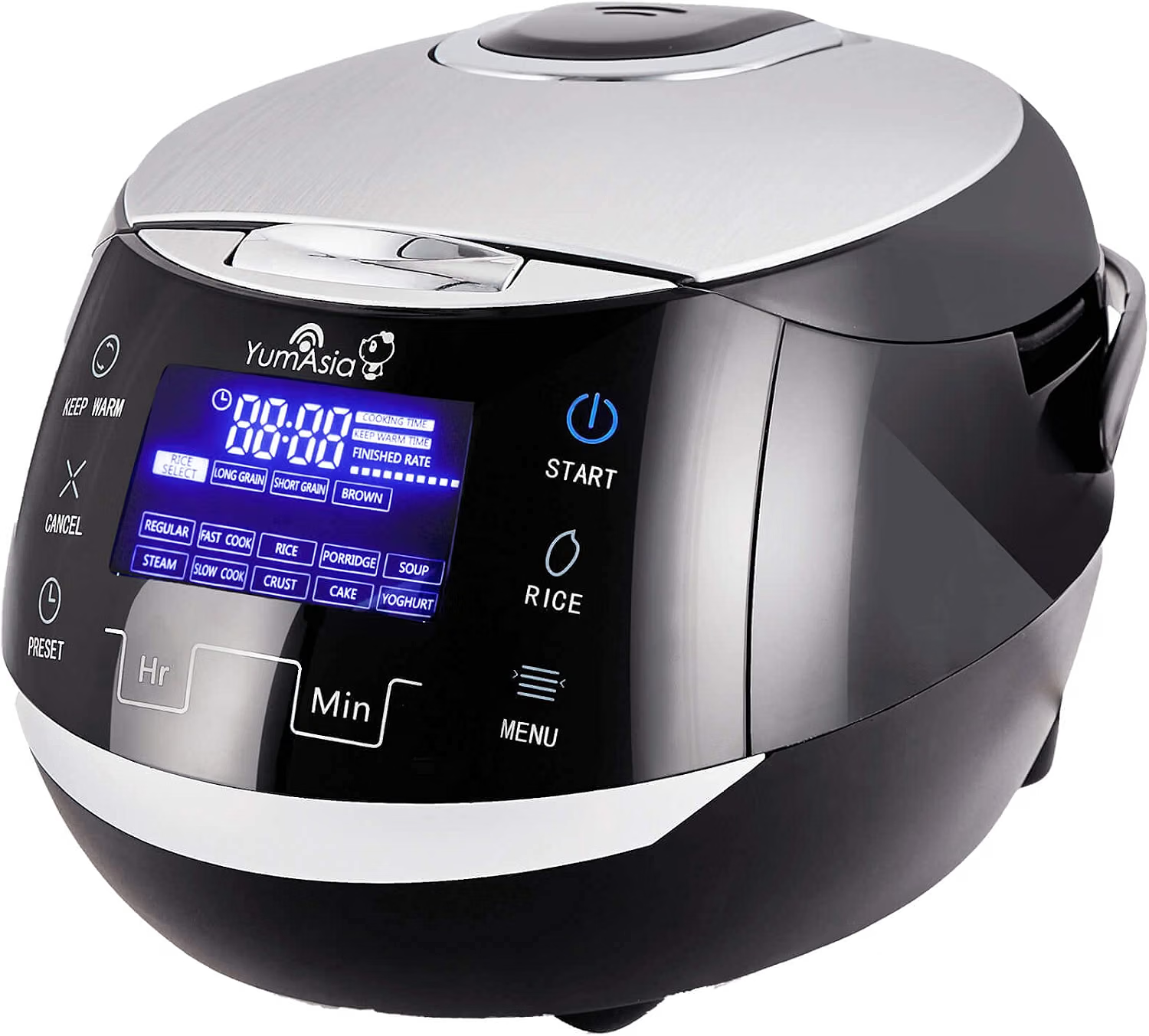
Yum Asia is a rice cooker brand that built its reputation by bringing Japanese-style cooking technology to UK, EU, and US kitchens at a more accessible price. Its lineup — including the Sakura, Panda Mini, and Kumo — relies on multi-phase fuzzy logic to adjust temperature automatically, paired with a PFAS-free ceramic inner bowl instead of a traditional non-stick coating. The pitch is simple: near-premium rice quality without the premium footprint or price of brands like Zojirushi.
What Is Cuckoo?
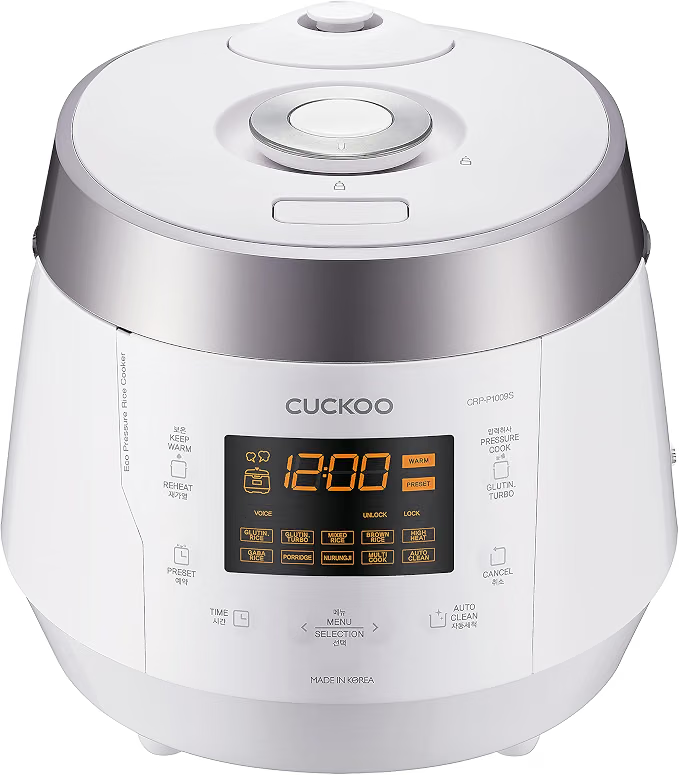
Cuckoo is a South Korean appliance maker known for combining induction heating with pressure cooking in the same unit — a “Twin Pressure IH” system that lets you toggle between chewy, high-pressure rice and softer, non-pressure rice. Cuckoo’s range spans simple one-touch models for beginners up to premium IH pressure cookers with voice guidance, auto-clean cycles, and quiet-steam technology. Made-in-Korea manufacturing and tight quality control are a core part of the brand’s identity.
Yum Asia vs Cuckoo: Which Cooks Rice Better?
Cuckoo’s induction and pressure models generally produce more consistent texture across rice types, especially brown rice and mixed grains, because pressure shortens cook time and breaks down tougher grains more evenly. Yum Asia’s fuzzy logic still produces excellent, restaurant-quality white and sushi rice, and many long-term owners report no meaningful texture difference for everyday white rice.
If your household eats mostly white rice, jasmine rice, or sushi rice, the difference is minor. If you regularly cook brown rice, GABA rice, or mixed grains, Cuckoo’s pressure function gives it a real edge.
Yum Asia vs Cuckoo: Price and Value
Yum Asia sits in the mid-range and consistently comes in cheaper than Cuckoo’s IH and pressure models, while still offering fuzzy-logic AI cooking and a premium ceramic bowl. Cuckoo’s basic one-touch models can be similarly priced or cheaper, but its flagship IH pressure cookers cost noticeably more.
Budget-focused buyers who still want smart cooking technology tend to land on Yum Asia. Buyers who see rice cooking as a long-term kitchen investment and want pressure/IH performance often accept Cuckoo’s higher price.
Yum Asia vs Cuckoo: Build Quality and Materials
Asia uses a PFAS-, PFOA-, PTFE-, and BPA-free ceramic coating on its inner bowl, which appeals to health-conscious buyers who want to avoid traditional non-stick chemicals. Cuckoo typically uses non-stick or diamond-coated stainless steel pots, which are extremely durable and handle high-pressure cooking well but aren’t marketed as PFAS-free.
If avoiding non-stick chemical coatings is a priority, Yum Asia has the clearer advantage. If you want a pot built to withstand years of high-pressure cycles, Cuckoo’s stainless steel construction is the more battle-tested choice.
Yum Asia vs Cuckoo: Capacity and Family Size
Yum Asia’s range tops out around 8 cups uncooked, aimed mainly at singles, couples, and small-to-medium households. Cuckoo covers a much wider range, from compact 3-cup models up to large 20-cup cooked capacity units designed for bigger families or batch cooking.
- 1–2 people: Yum Asia Panda Mini (3.5 cups) or a compact Cuckoo 3-cup model both work well.
- 3–4 people: Yum Asia Sakura or Kumo, or a Cuckoo 6-cup twin pressure model.
- 5+ people or batch cooking: Cuckoo’s larger IH models are the stronger fit — Yum Asia doesn’t compete at this capacity tier.
Yum Asia vs Cuckoo: Features and Cooking Modes
Both brands go well beyond basic rice cooking. Yum Asia models typically include steam, slow cook, porridge, and cake functions alongside a 24-hour timer and keep-warm. Cuckoo models often add more menu modes (15–25 depending on model), a voice guide in multiple languages, auto-clean cycles, and a twin pressure toggle for adjusting rice texture on demand.
If you want more granular control and voice feedback, Cuckoo’s feature set is deeper. If you want a simpler, still-versatile multicooker, Yum Asia covers most everyday needs without overwhelming menus.
Yum Asia vs Cuckoo: Ease of Use and Noise
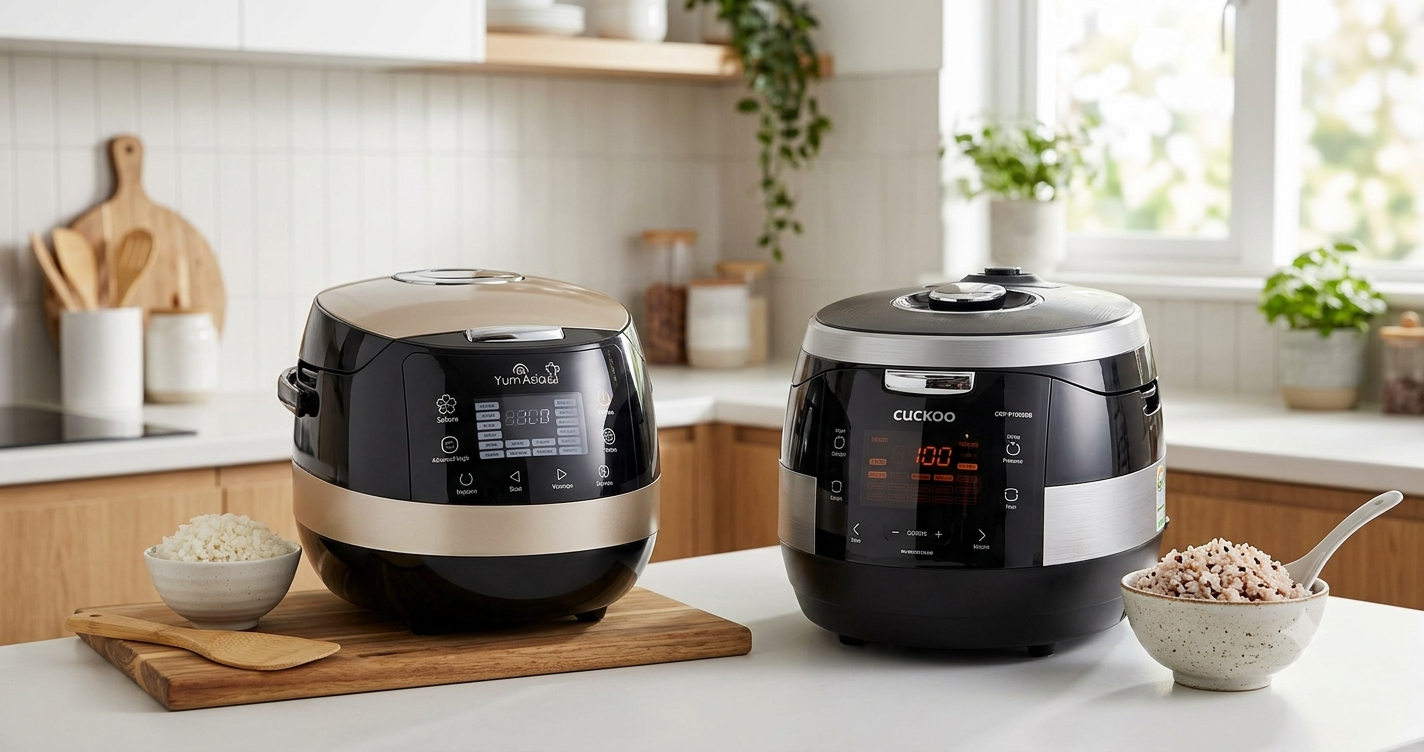
Yum Asia’s interface is generally considered simpler and more beginner-friendly, with fewer menu options to navigate. Cuckoo’s premium models add a voice guide that talks users through each stage, which some find helpful, and others find unnecessary. On noise, older Cuckoo pressure models could be loud during steam release, though newer “Silence” series units have significantly reduced operating noise.
Yum Asia vs Cuckoo: Durability and Long-Term Reliability
Both brands have strong reputations for longevity. Yum Asia owners frequently report five or more years of daily use, with only the ceramic bowl eventually needing replacement — a cheaper fix than replacing the whole unit. Cuckoo owners commonly report seven to ten years of reliable use, backed by the brand’s reputation for strict Korean manufacturing standards.
Who Should Buy a Yum Asia Rice Cooker?
- You’re cooking for 1–4 people and mostly eat white, jasmine, or sushi rice.
- You want a PFAS-free ceramic bowl over traditional non-stick coatings.
- You want near-premium rice quality without paying premium prices.
- You prefer a simpler control panel over a long list of menu modes.
- You have limited counter space and don’t need a voice guide.
Who Should Buy a Cuckoo Rice Cooker?
- You cook brown rice, GABA rice, or mixed grains regularly.
- You want the option to switch between pressure and non-pressure cooking.
- You’re cooking for a larger family or need bigger capacity options.
- You want a voice guide and a wider range of menu modes.
- You’re willing to pay more for induction heating and pressure performance.
Frequently Asked Questions
Is Cuckoo better than Yum Asia?
Cuckoo generally performs better for brown rice, mixed grains, and larger households thanks to its induction heating and pressure cooking options. Yum Asia is the better pick for everyday white rice, smaller households, and buyers who want strong performance at a lower price.
Is Yum Asia worth the money?
For most single-person or small-household buyers who mainly eat white or sushi rice, yes — Yum Asia delivers fuzzy-logic AI cooking and a PFAS-free ceramic bowl at a price well below premium Japanese brands, and owners commonly report years of reliable daily use.
Does Cuckoo use pressure cooking?
Many Cuckoo models, especially the Twin Pressure and IH Pressure lines, combine induction heating with pressure cooking, letting you switch between high-pressure and non-pressure settings depending on the rice type and texture you want.
Which brand is better for brown rice?
Cuckoo’s pressure models typically handle brown rice better, since pressure shortens cooking time and softens tougher grains more evenly than standard fuzzy-logic heating alone.
Which rice cooker is easier for beginners?
Yum Asia’s simpler menu structure tends to be easier for first-time smart rice cooker buyers, while Cuckoo’s voice-guided premium models can help beginners but come with more settings to learn.
Do either of these brands make rice cookers without non-stick coatings?
Yum Asia’s ceramic bowls are marketed as PFAS-, PFOA-, PTFE-, and BPA-free, which is a specific selling point for buyers avoiding traditional non-stick chemicals. Cuckoo’s standard inner pots use non-stick or diamond coatings rather than ceramic.
Final Verdict
There’s no universal winner here — the right choice depends on what you actually cook and how many people you’re feeding. If brown rice, mixed grains, or big-batch cooking are part of your routine, Cuckoo’s induction and pressure technology earns its higher price. If you mainly eat white or sushi rice, cook for one to four people, and want strong performance without a premium price tag, Yum Asia is the smarter buy.
Both brands have loyal long-term users and strong reliability track records, so whichever you choose, you’re buying into a rice cooker built to last — not just a one-season kitchen gadget.