No — a modern dishwasher is one of the cheaper appliances to run. A standard cycle uses roughly 1–2 kWh of electricity, which typically costs $0.15–$0.30 per load at current U.S. electricity rates. Run four to five times a week, that adds up to about $2–$6 a month, or roughly $35–$70 a year for an ENERGY STAR-certified model. Older units (pre-2013) can cost two to three times that.
Below, we break down exactly where that electricity goes, how your model and habits change the number, and how dishwashers compare to washing dishes by hand.
Read More: Why Does Your Bosch Dishwasher Stop Mid-Cycle?
Table of contents
How Much Electricity Does a Dishwasher Actually Use?
Most residential dishwashers are rated between 1,200 and 2,400 watts, with 1,800 watts being a common average. But that “rated wattage” is the peak draw — not what the machine pulls for the whole cycle.
In practice, a dishwasher only runs at full power in short bursts, mainly while heating water. Averaged across an entire cycle, actual draw is closer to 50–60% of the rated wattage. That’s why a 1,800-watt dishwasher running for 90 minutes to 2 hours typically uses about 1.0–2.0 kWh per load, not the 3+ kWh you’d get by simply multiplying watts by hours.
Where the electricity goes during a cycle:
| Phase | Share of Energy Use | Notes |
|---|---|---|
| Heating the wash water | ~45–50% | The largest single draw; heats water to 120–140°F |
| Wash/rinse motor & pump | ~15–20% | Runs continuously at 100–300 watts |
| Heated drying | ~25–40% | Optional — skipping it is the easiest way to cut costs |
Under current ENERGY STAR requirements, a standard-size certified dishwasher must use no more than about 240 kWh per year (based on 215 cycles). Older, pre-2013 models with no efficiency standard can use up to 800 kWh a year — three to four times as much.
What Does It Cost to Run a Dishwasher? (Per Cycle, Month, and Year)
Using a national average electricity rate of roughly $0.14–$0.19 per kWh:
| Timeframe | Energy Used | Estimated Cost |
|---|---|---|
| Per cycle | 1.0–2.0 kWh | $0.15 – $0.30 |
| Per month (4–5 loads/week) | 18–36 kWh | $2.50 – $6.00 |
| Per year (ENERGY STAR model) | ~240 kWh | $35 – $45 |
| Per year (older, pre-2013 model) | up to 800 kWh | $110 – $150 |
Your actual number depends heavily on where you live. Electricity rates vary widely by state:
- Lower-cost states (e.g., North Dakota, Louisiana): around $0.11–$0.12/kWh
- National average: roughly $0.14–$0.19/kWh
- Higher-cost states (California, Hawaii, parts of New England): $0.25–$0.40/kWh
In a high-rate state, running a dishwasher daily can push annual electricity costs toward $100–$180, even with an efficient machine.
Does the Cycle You Choose Change the Cost?
Yes — significantly. Not all cycles use the same amount of energy:
- Eco/normal cycle: roughly 1.0–1.4 kWh. Runs longer but at lower heat, using 30–40% less energy than an intensive cycle.
- Heavy/intensive cycle: roughly 2.2–2.8 kWh. Higher water temperature and longer heating time.
- Quick wash: surprisingly, this isn’t always the cheapest. It uses high wattage for a shorter time to force fast results, so total energy use is close to a normal cycle.
- Heated dry (add-on to any cycle): adds about 0.3–0.6 kWh, which is 25–40% of a normal cycle’s total energy.
Quick takeaway: If you want to cut costs without buying a new machine, switch to the eco cycle and turn off heated drying. That alone can save $15–$35 a year.
Is It Cheaper to Hand-Wash Dishes or Use a Dishwasher?
For most households, the dishwasher wins — despite feeling like the “bigger” appliance. Here’s why:
- A dishwasher recirculates a fixed, small amount of water rather than running a tap continuously.
- Most of the actual energy cost of dishwashing — hot water — is heated more efficiently in bulk by a dishwasher than by leaving a hot tap running for the 10–15 minutes it typically takes to hand-wash a full load.
- Hand-washing with a continuously running hot tap can use several times more hot water than a full dishwasher cycle.
Hand-washing can be cheaper only if you wash in a partially filled basin with the tap off between rinses — but very few people actually do this consistently.
Does Dishwasher Age Matter?
A lot. This is one of the biggest hidden factors in your electric bill:
- Pre-2004 models: no federal efficiency standard existed; can use up to 800 kWh/year.
- Pre-2013 models: improved but still inefficient by modern standards.
- Current ENERGY STAR models: capped around 240 kWh/year, with the most efficient units closer to 200 kWh/year.
Upgrading from an older machine to a new ENERGY STAR-certified dishwasher can cut annual electricity costs by roughly $30–$60, on top of using significantly less water per cycle.
7 Practical Ways to Lower Your Dishwasher’s Electricity Cost
- Skip heated drying. Use the air-dry or “open door” option instead — the single biggest easy saving.
- Use the eco cycle for normally soiled dishes instead of the heavy/intensive cycle.
- Only run full loads. A half-empty dishwasher uses nearly the same energy as a full one.
- Lower your water heater slightly (but keep it at a safe, effective temperature) — a dishwasher fed cooler-than-optimal water has to work harder internally, raising usage 15–25%.
- Run it during off-peak hours if your utility offers time-of-use pricing; this can cut effective costs by 20–40% without changing energy use at all.
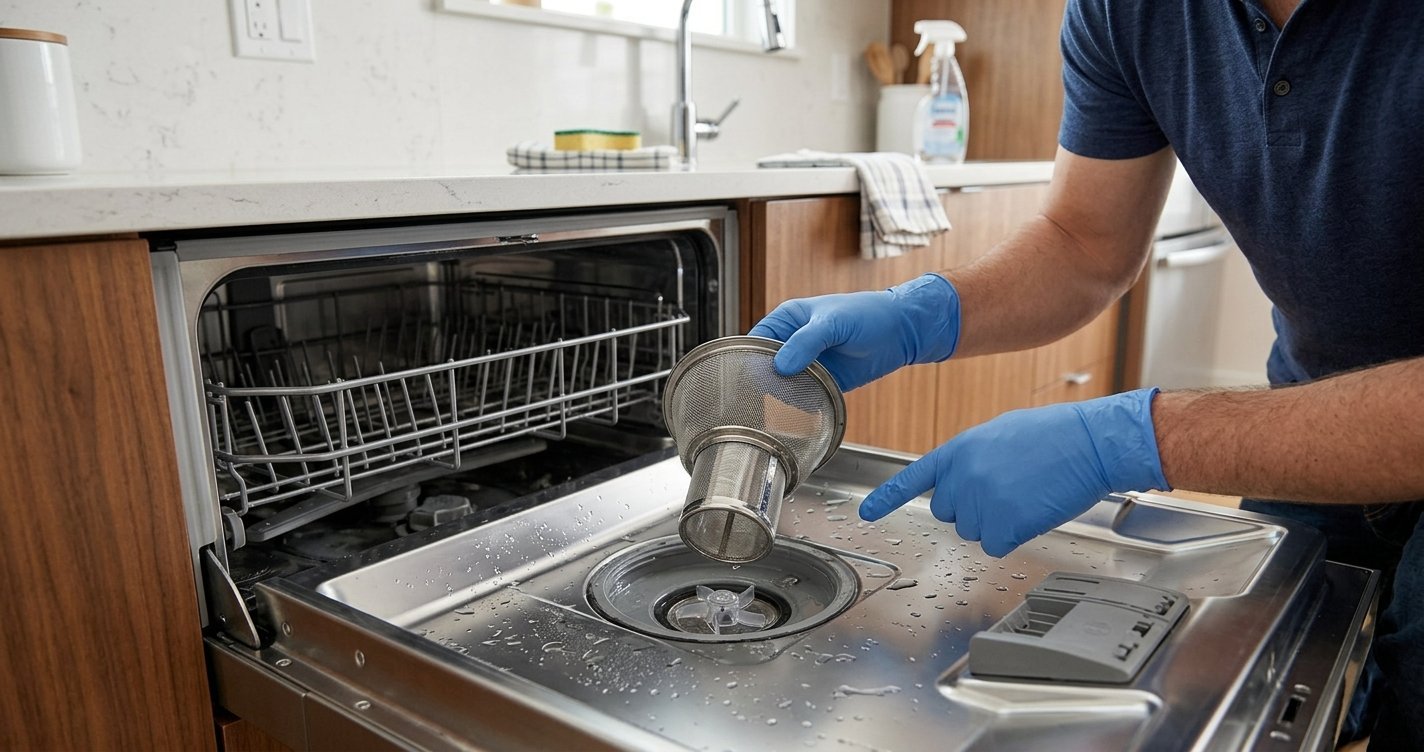
- Clean the filter monthly. A clogged filter forces longer, less efficient cycles.
- Run hot water at the kitchen tap briefly before starting the cycle so the dishwasher doesn’t begin by heating cold water from scratch.
Frequently Asked Questions
Does running a dishwasher every day use a lot of electricity?
Not really. Daily use with an efficient model typically adds up to $3–$6 a month — comparable to or less than many other kitchen appliances.
Do dishwashers use more electricity or water?
Water heating is the largest single cost driver in a dishwasher cycle, but overall, dishwashers use less water and often less total energy than hand-washing an equivalent load.
Is it cheaper to run the dishwasher at night?
Only if your utility charges time-of-use rates. The dishwasher uses the same amount of energy regardless of time — but off-peak electricity can be 20–40% cheaper per kWh in some areas.
How many watts does a dishwasher use?
Most models are rated between 1,200 and 2,400 watts, with 1,800 watts being typical. Average draw across a full cycle is usually closer to 900–1,000 watts.
Do older dishwashers use a lot more electricity than new ones?
Yes. A pre-2013 dishwasher can use two to three times more electricity annually than a current ENERGY STAR-certified model.
Does heated dry use a lot of electricity?
It’s one of the biggest optional costs in a cycle — typically 25–40% of total energy use. Skipping it is the easiest way to cut your dishwasher’s electric bill.
The Bottom Line
Dishwashers are not a significant electricity drain for most households. A modern, ENERGY STAR-certified model typically costs somewhere between $35 and $70 a year to run — less than many people assume, and generally less than the cost of hand-washing an equivalent number of loads. The biggest levers you actually control are cycle choice, heated drying, load size, and — if your machine is more than a decade old — whether it’s time to upgrade.