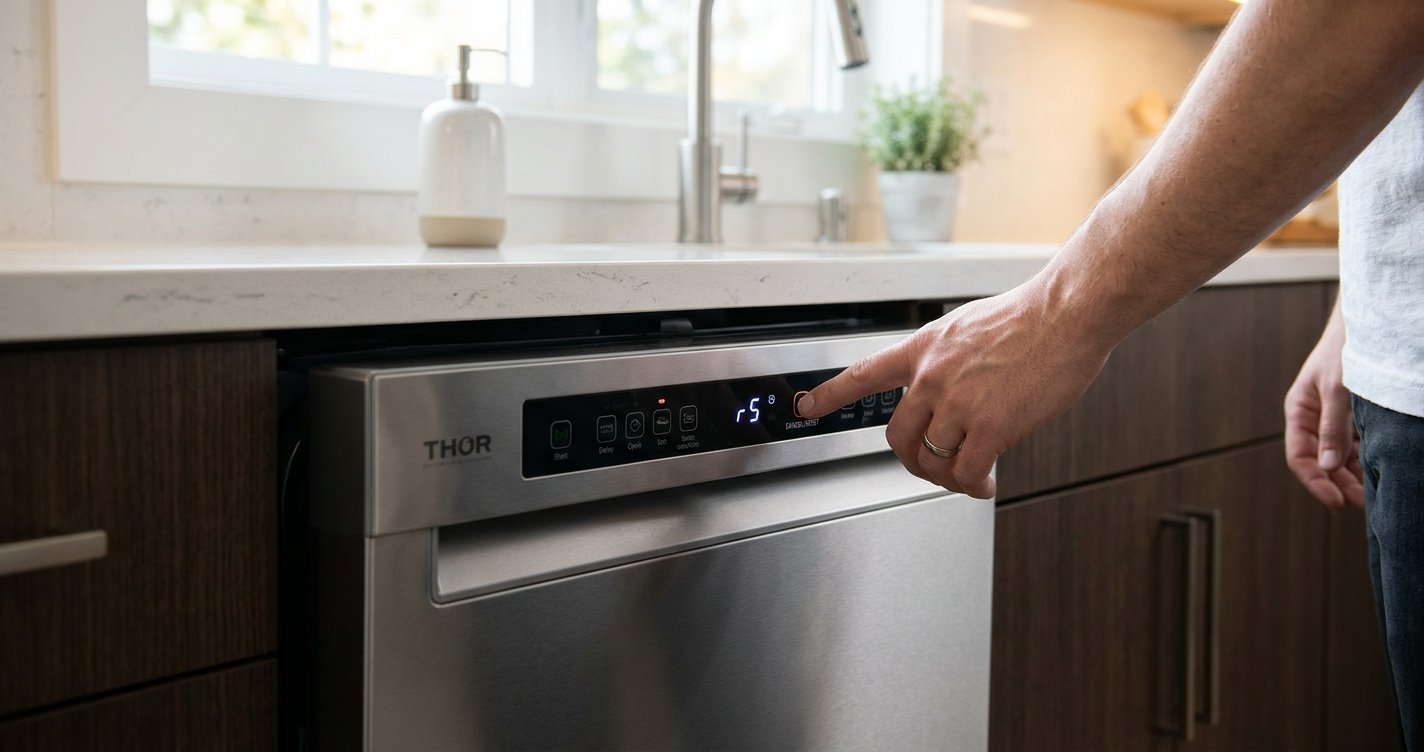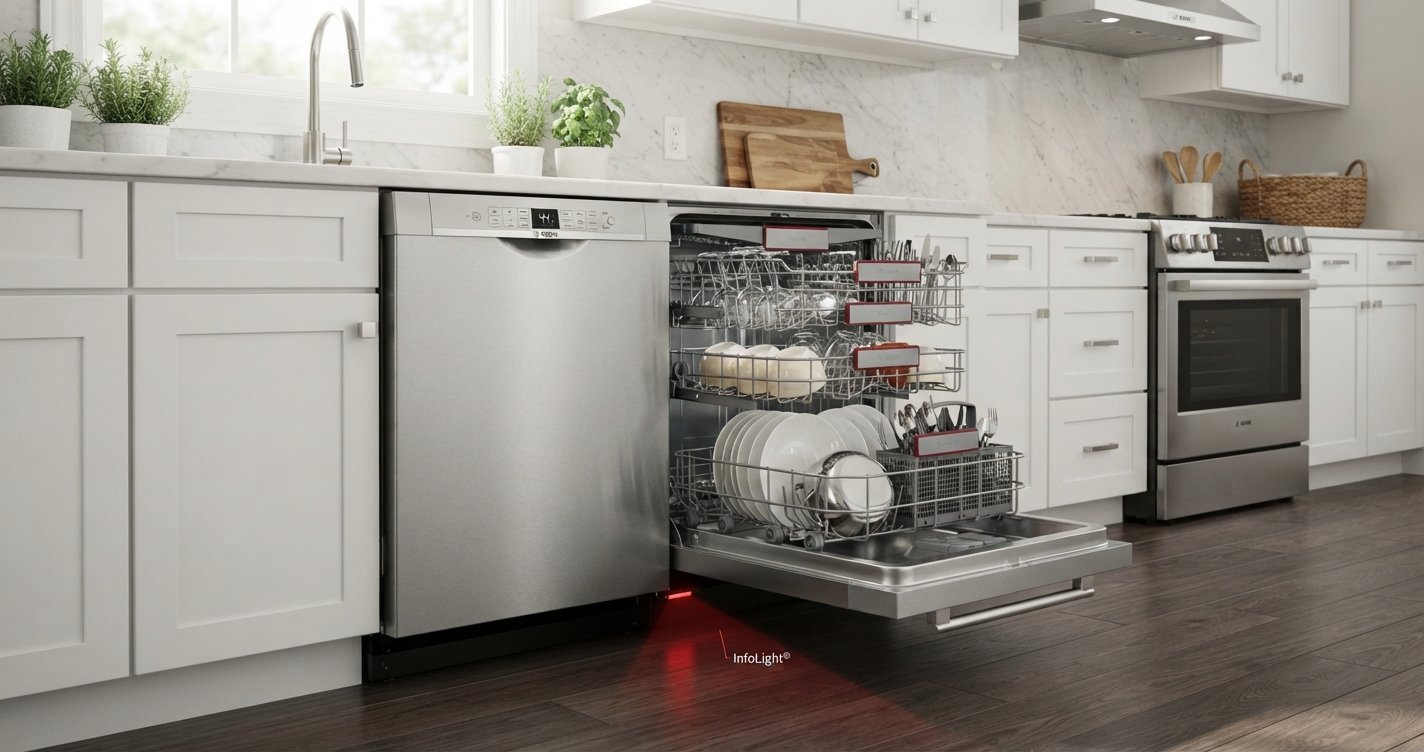
A dishwasher that trips the breaker usually has an electrical fault: current leaking to ground or a short, most often in the heating element, a motor or pump, or loose or damaged wiring. To narrow it down, note when the trip happens (at power-on, when the heater turns on, or during a particular stage), then cut power at the breaker and test or inspect the suspect part. Don’t keep resetting the breaker. If you aren’t comfortable testing line-voltage parts, or the breaker trips the moment you reset it with the machine idle, call a technician or electrician.
Read More: How to Use the Sanitize Cycle on a Bosch Dishwasher
Table of contents
Safety First
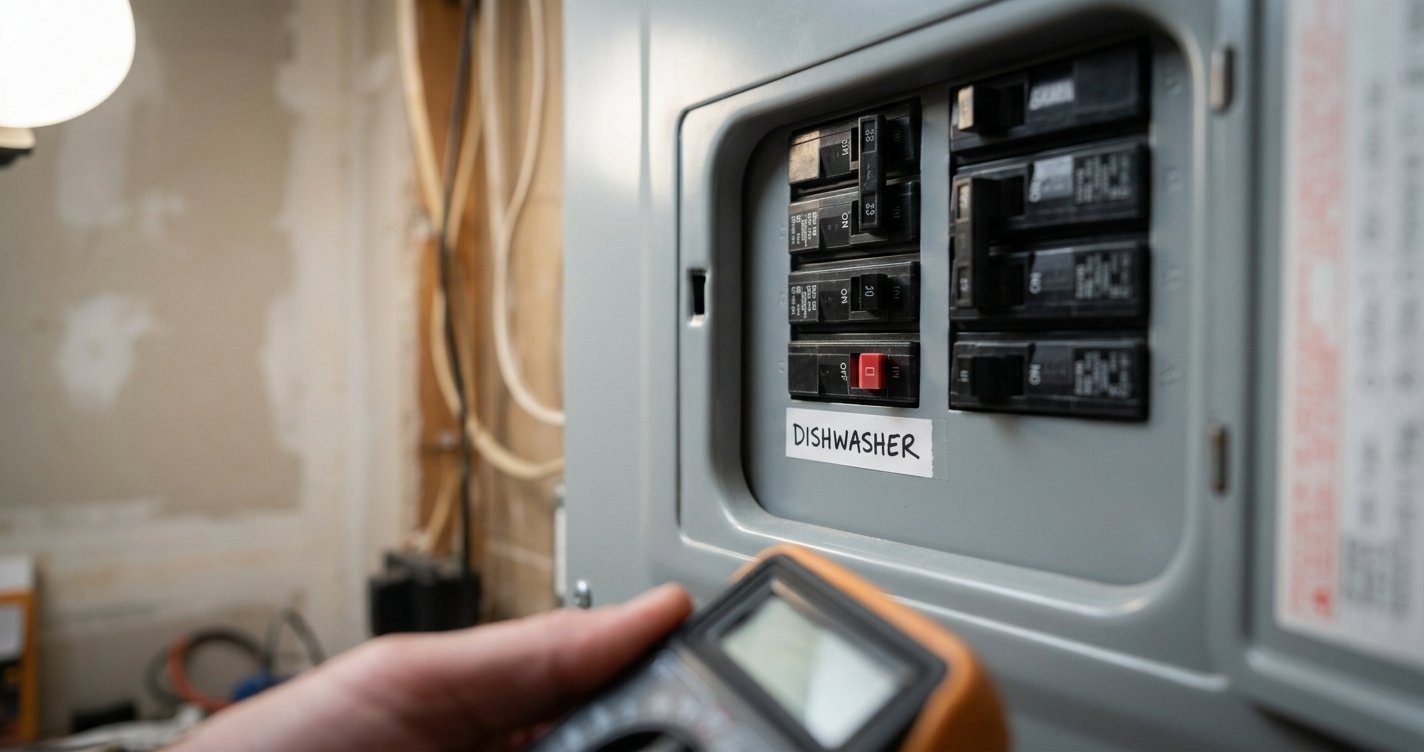
- Cut power before any inspection. Switch off the breaker and confirm the circuit is dead. Unplugging or removing the fuse also works where applicable (PartSelect).
- Shut off the water supply too. How To Fix It says to disconnect all electrical and water supplies to the unit before internal work.
- Don’t reset the breaker repeatedly. A repair company’s page warns that repeated resets are risky and the root cause should be found (EasyBear). That page is a company’s marketing, and the other sources I read don’t address resetting.
- Leave house wiring and the breaker panel to a licensed electrician.
Step 1: Work Out When It Trips
The timing is the most useful clue. The sources link it to these likely causes:
| When it trips | Likely cause | Source |
| Right when you turn it on | Loose, overheated,d or damaged connection in the junction box, or a hard short in the wiring or board | EasyBear (Bosch and GE pages) |
| When the heater comes on, or on hot cycles such as Sani or Heavy | Heating element | EasyBear, How To Fix It |
| During wash or during drain | Wash motor or drain pump | EasyBear |
| At the end of the cycle | Heater circuit or control board | How To Fix It (author’s reply to a reader) |
| Randomly, on a GFCI-protected circuit | Nuisance trip, or leakage from an aging appliance | EasyBear, forum posters |
A quick test suggested for Bosch models: run a short cycle with no heat. If the breaker holds, the heater is the likely cause (EasyBear). That page is a repair company’s marketing, and I couldn’t verify its claims independently, so treat the table as a starting point, not a diagnosis.
Step 2: Check the Circuit
Before opening the dishwasher:
- Is it a GFCI or a regular breaker? How To Fix It says that if the dishwasher’s own GFCI trips, the fault is probably in the dishwasher. If the house breaker trips, the problem may be elsewhere.
- Is the breaker the right size for the wire? A reply by the How To Fix It author warns that a 30-amp breaker is too big for a circuit fed by 12-gauge wire. The same reply says the dishwasher needs only about 10 amps. That’s one reply on a repair site, so ask an electrician to confirm your circuit.
- Is the dishwasher on its own circuit? EasyBear says to confirm it has a dedicated circuit, since sharing one with a disposal or microwave can overload the breaker.
- Is the breaker itself worn? The same page mentions checking that the breaker is the correct rating and not worn. An electrician can test it.
Step 3: Inspect the Likely Culprits
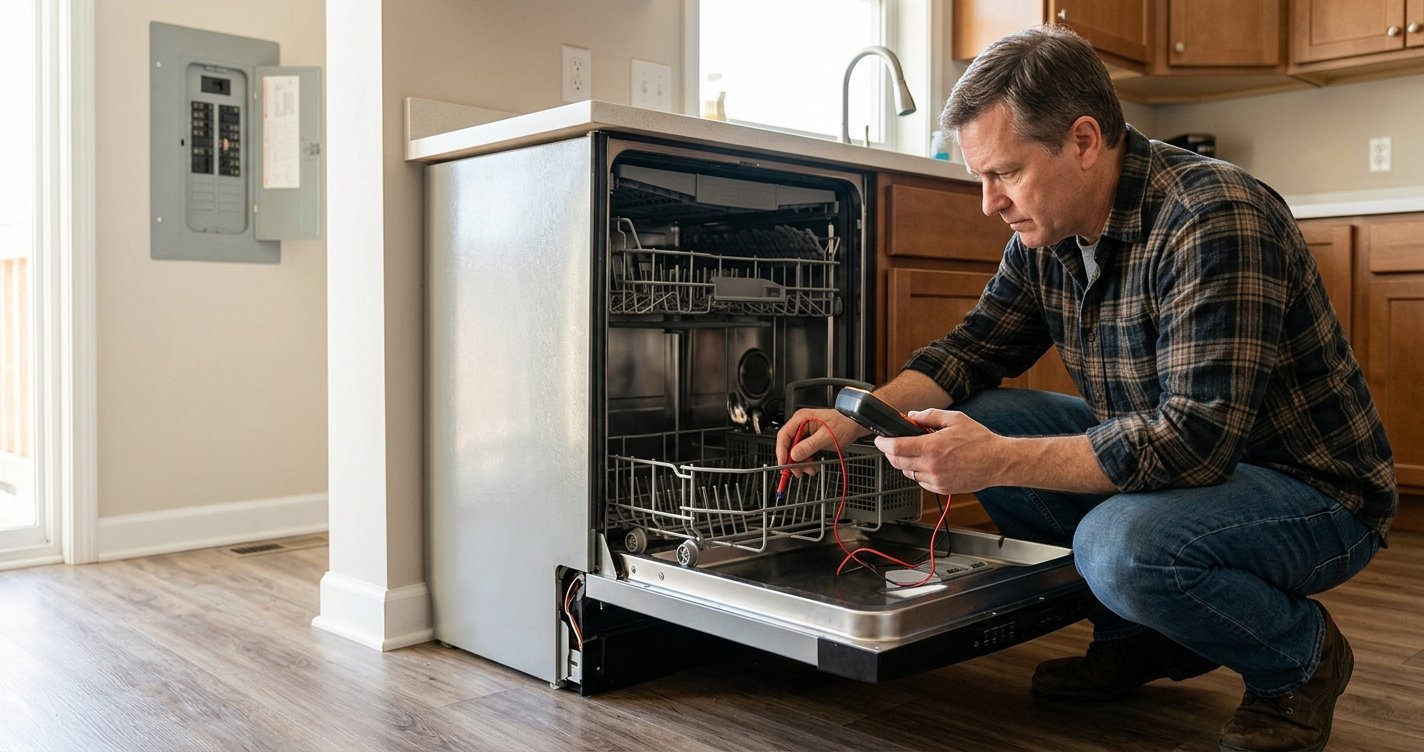
With the power off and the water shut off, remove the lower kickplate (usually held by at least two screws, per PartSelect) and look at the following.
The heating element
How To Fix It says damage from plate hits or pits in the element can cause excess draw or a short, and that you should replace the element rather than repair it, using a model-compatible part. It lists an element at $21 to $48 (from an Amazon listing).
To test it, PartSelect gives these steps:
- Cut power. Find the thin, circular tube at the base of the tub.
- Remove the lower kickplate to reach the wiring.
- Label the wires, then pull the slip-on connectors off by the connector, not the wire.
- Set a multimeter to ohms (x1) and touch a probe to each terminal. You don’t need to remove the element.
- A reading of infinite or zero suggests a faulty element. PartSelect gives no specific ohm value because it varies by model.
EasyBear adds a ground test: meter each element terminal to the tub, and anything other than infinite resistance indicates a ground fault. It notes that even a megohm or two of leakage can trip a 120V GFCI. That is a repair company’s claim.
The motor and pumps
EasyBear says a wash motor or drain pump can leak current to its housing, often after overheating from a seized bearing or jam. To test, disconnect the motor harness and meter each lead to the housing. Infinite resistance is good, and any reading means the insulation has failed. How To Fix It says a worn motor can also draw excess amps, and that motor access is through the bottom, so drain the water first.
Wiring and connectors
- Junction box. EasyBear lists it as a common trouble spot, with chafed insulation, nicks, or loose wire nuts. How To Fix It says inspecting it is unlikely to find the problem but is quick to rule out.
- Loose or exposed connectors. How To Fix It says to reattach and tighten loose ones and replace any exposed wires.
- Pinched harness. EasyBear lists a chafed internal harness near the door hinge and pump area as the least common cause.
The control board and transorb
How To Fix It lists two further causes: a shorted transorb (TVS diode), which can also damage the control board, and a control board with burn damage or moisture. It calls the board a last resort and recommends a professional for connectors, the transorb, the board, and the motor.
Water getting where it shouldn’t
Water from a leak can wet connectors or electronics (EasyBear). In one forum thread, a poster found a leaking fill hose, and another suggested a dried-out detergent dispenser O-ring could drip onto the heaters. Those are individual posters’ theories, but they show why fixing leaks can matter for an electrical fault.
What About GFCI Protection?
Posters in a forum thread disagree on this, and the thread is old and unofficial:
- One poster’s electrician said the dishwasher shouldn’t have been on a GFCI and that an aging appliance’s leakage can trip it. Running it on a standard outlet worked.
- Another poster said it should be hardwired or off a GFCI because a properly grounded unit poses little shock risk.
- A third cited the 2017 NEC as requiring GFCI protection for dishwashers, which conflicts with the second view. I couldn’t verify that claim.
- Another advised using a 20A GFCI on a 20A circuit to reduce nuisance tripping.
What this means: GFCI rules depend on your local electrical code and your installation. Don’t remove or bypass GFCI protection on a guess. Ask a licensed electrician what your code requires. An older GFCI that trips on normal leakage is one possible cause (EasyBear), but check for a real fault first.
Repair or Replace the Dishwasher?
I couldn’t find reliable repair-cost figures beyond the element price. EasyBear’s page lists a free diagnostic visit and DIY tool costs of about $60 (a water pressure gauge) and $85 (a multimeter). It estimates $150 to $400 for an average DIY attempt, which is the company’s own estimate. A common rule of thumb is to weigh the repair against about half the price of a new unit, but I found no source that sets that for this problem. Age, the part that failed, and whether the control board is damaged all matter.
When to Call a Professional
Call a licensed appliance technician or electrician if:
- You are not comfortable working with line-voltage connections or meter readings to the chassis (EasyBear).
- The breaker trips the moment you reset it with the machine idle, which EasyBear calls more serious.
- The fault looks like house wiring or the breaker panel (EasyBear assigns that to a licensed electrician).
- The cause points to a connector, the transorb, the control board,d or the motor, where How To Fix It recommends a professional.
- You see burn marks, melted wire nuts, or a burning smell. That’s my own advice, not a source claim.
How to Prevent It
- Fix leaks promptly so water doesn’t reach electrical parts.
- Keep the dishwasher on its own circuit with the right breaker for the wire (confirm with an electrician).
- Clear jams in the pump area, since a jam can overheat the motor (EasyBear).
- Avoid hitting the heating element with dishes and pots when loading (How To Fix It mentions plate hits damaging it).
These steps lower risk. I found no source showing they prevent every trip.
Frequently Asked Questions
Why does my dishwasher keep tripping the breaker?
Usually an electrical fault such as a heating element, motor, or pump leaking current, damaged wiring, a shorted transformer,b or a failing control board. Timing helps narrow it down.
Is it safe to keep resetting the breaker?
No. A repair company’s page warns that repeated resets are risky and the cause should be found first.
What is the most common cause?
Sources point to the heating element and motor or pump windings, but the percentages quoted by one repair company are its own and unverified. I wouldn’t treat any single cause as certain.
How do I know if the heating element is bad?
Cut power, disconnect the element’s wires, and test it with a multimeter. PartSelect says an infinite or zero reading suggests a faulty element. Also test each terminal to the tub, where anything other than infinite resistance indicates a ground fault (EasyBear).
Why does it trip only on hot cycles?
EasyBear says a heating element ground fault is most likely to trip on Sani Rinse or Heavy cycles, when the element runs hottest.
Why does it trip as soon as I turn it on?
Possibly a loose, overheated, or damaged junction box connection, or a hard short in the wiring or board.
Could the GFCI be the problem?
Possibly. EasyBear says an older GFCI can trip on normal leakage, and one forum poster’s electrician said the same about an aging appliance. Rule out a real fault first and ask an electrician about your code.
Conclusion
To fix a dishwasher that trips the breaker, shut off the power and water, work out when the trip happens, and test the usual suspects: the heating element, the motor and pumps, and the wiring and junction box. A bad element is a relatively cheap part, but motor, board, and wiring faults are better left to a professional, and you shouldn’t keep resetting the breaker or upsize it to get around the problem. If the breaker trips as soon as you reset it with the machine idle, or you suspect your house wiring, call a licensed electrician or appliance technician.