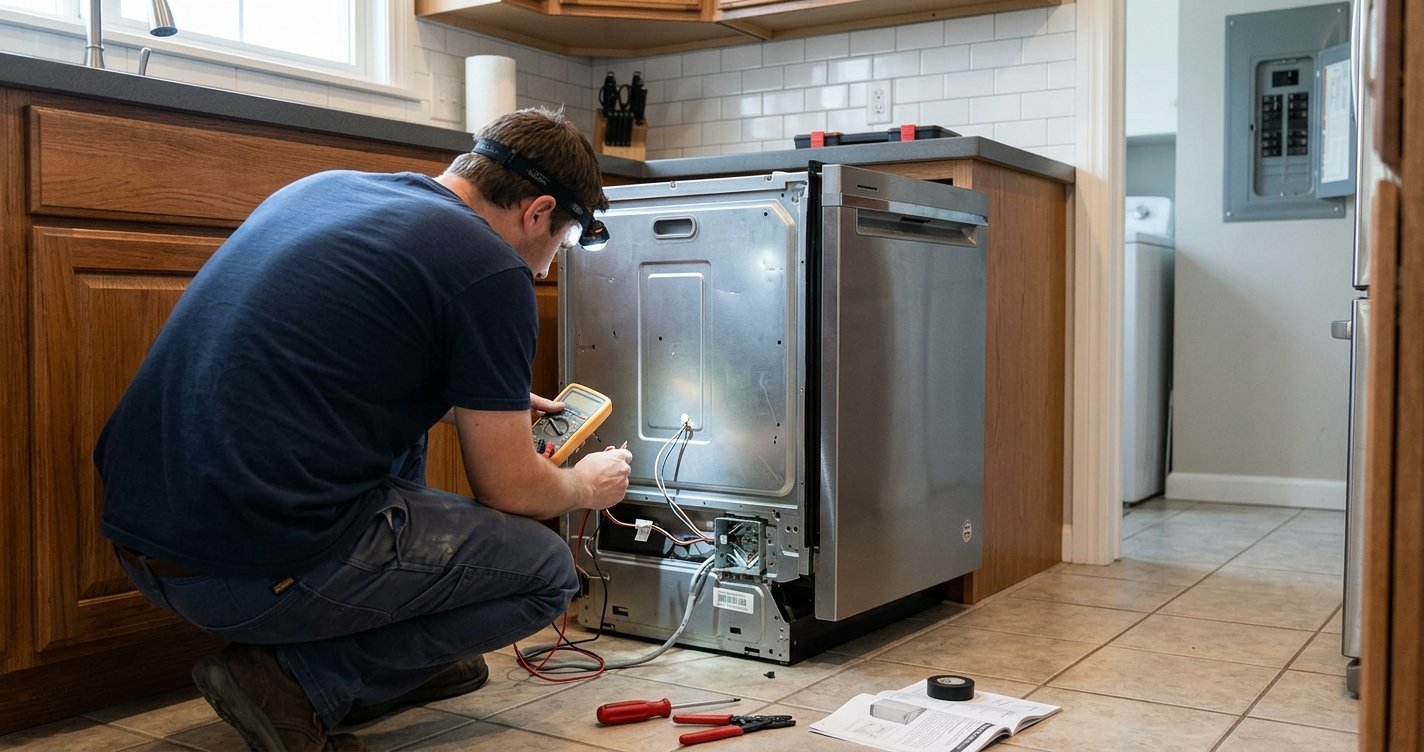
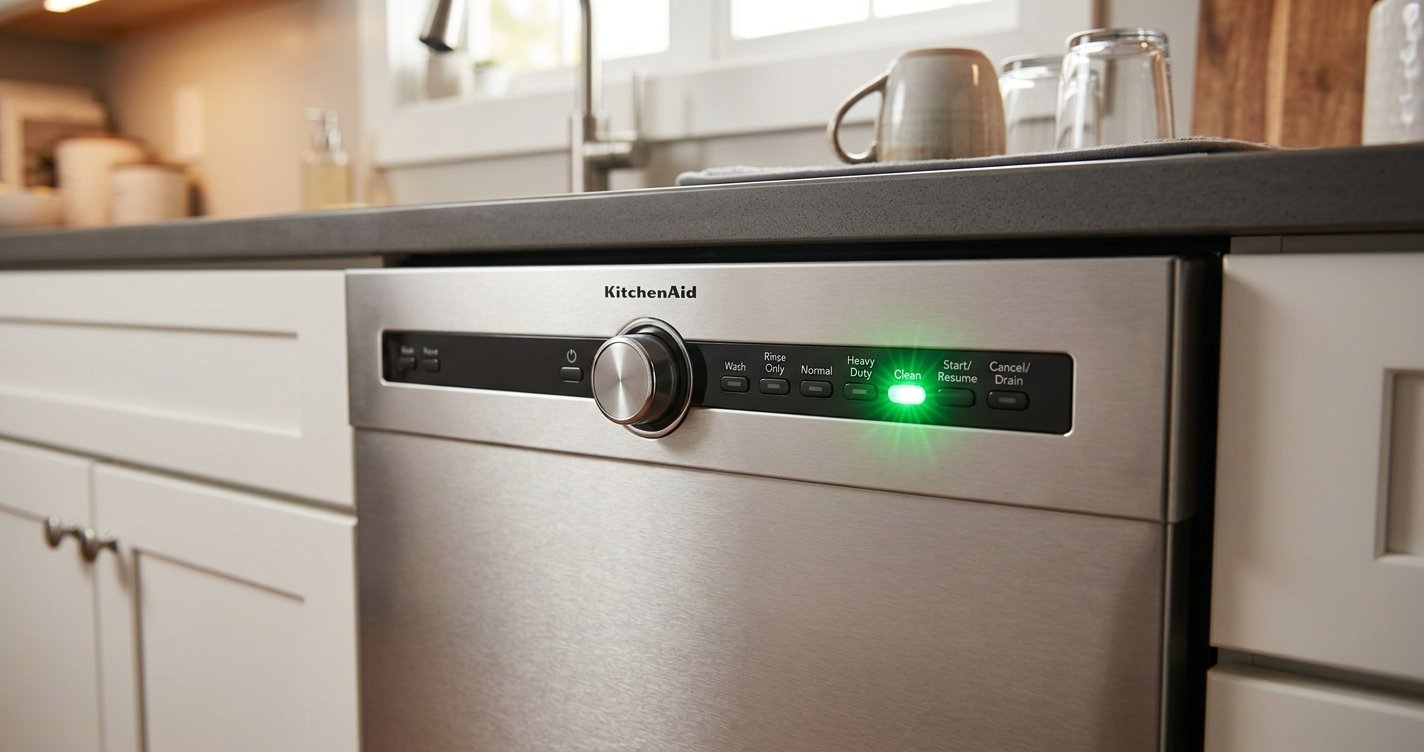
A blinking Clean light on a KitchenAid dishwasher usually indicates that the appliance has detected an issue rather than simply showing that the dishes are clean. On many KitchenAid models, the blinking pattern communicates an error code that can help identify the problem.
The exact meaning varies by model, so the safest approach is to identify the flashing pattern first and then follow the troubleshooting steps for your dishwasher.
Read More: KitchenAid KDTM404KPS Dishwasher Door Won’t Close
Table of contents
What Does a Blinking Clean Light Mean?
When the Clean light flashes repeatedly, KitchenAid says it can be an error-code communication. The dishwasher may use a two-part flashing sequence:
- Count the first group of flashes.
- Wait for the short pause.
- Count the second group of flashes.
- Wait for the longer pause before the sequence repeats.
For example, 7 flashes, a short pause, 1 flash, and then a longer pause represents an F7-E1 error code.
Because error codes vary between models, don’t assume that a particular number of flashes has the same meaning on every KitchenAid dishwasher.
Common Reasons the Clean Light Blinks
Several conditions can cause the Clean light to flash.
1. The Dishwasher Cycle Was Interrupted
If the door was opened during a cycle or the cycle was otherwise interrupted, the dishwasher may need to be resumed. KitchenAid manuals instruct users to press START/RESUME and, on some top-control models, close the door within about four seconds.
Make sure:
- The dishwasher door is fully closed.
- The latch engages properly.
- Nothing inside the dishwasher is preventing the door from closing.
- You press START/RESUME after closing the door as required by your model.
2. The Dishwasher Has Detected an Error
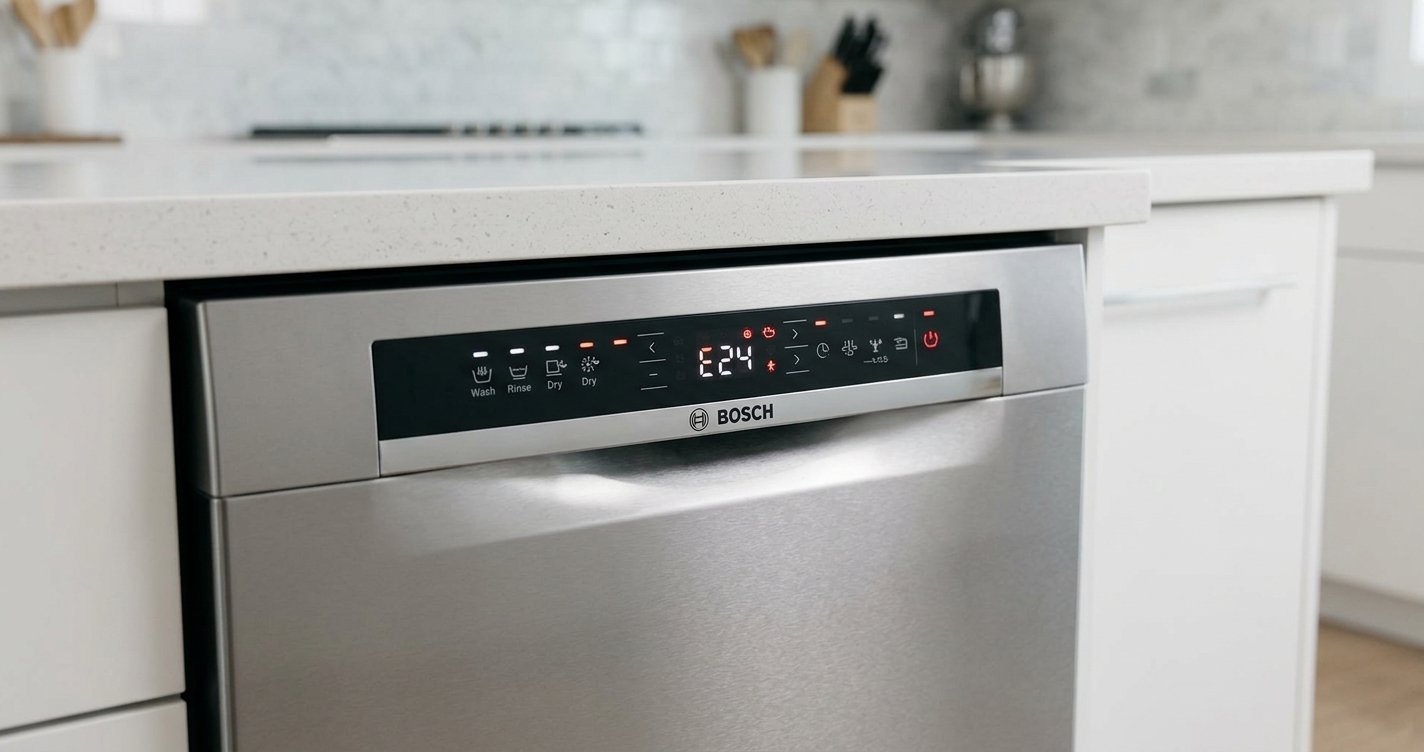
If the Clean light continues blinking and the dishwasher won’t operate normally, the flashing sequence may be reporting a fault. KitchenAid specifically recommends reading the two-part sequence to determine the corresponding F-E error code.
Write down the pattern before resetting the dishwasher. This can be useful if you need to consult the owner’s manual or arrange service.
3. A Temporary Control Problem
Sometimes an unexpected indicator light can result from a temporary control-system problem. KitchenAid recommends cycling power to reset the dishwasher controls.
A general reset procedure is:
Write down the pattern before resetting the dishwasher. This can be useful if you need to consult the owner’s manual or arrange service.
- Press Cancel/Drain if a cycle is active and allow the dishwasher to finish draining.
- Disconnect the dishwasher from power.
- Wait at least 30 seconds; KitchenAid’s current general reset guidance recommends waiting at least one minute.
- Restore power.
- Close the door, select a cycle, and press Start.
For a hard-wired dishwasher, switch off the appropriate circuit breaker rather than attempting to disconnect wiring yourself.
Check the Overfill Protection Float
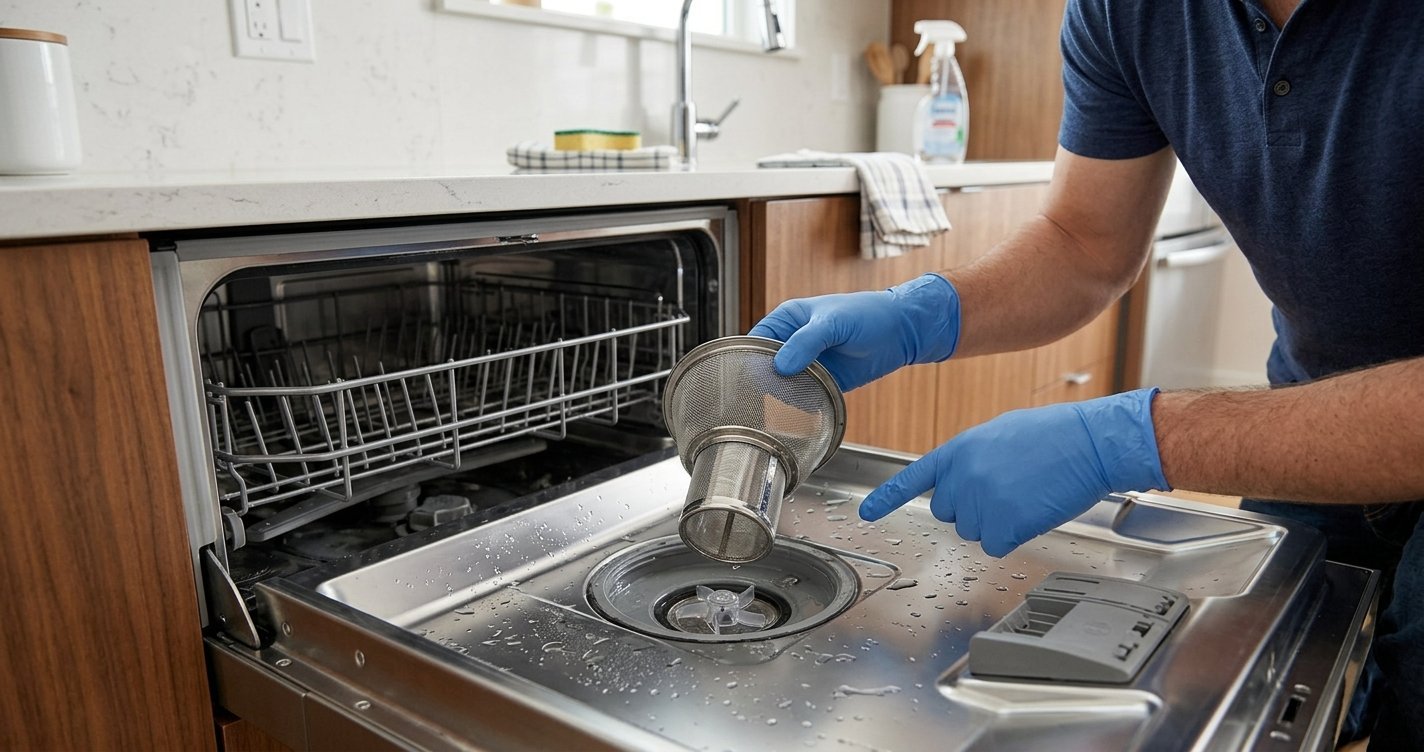
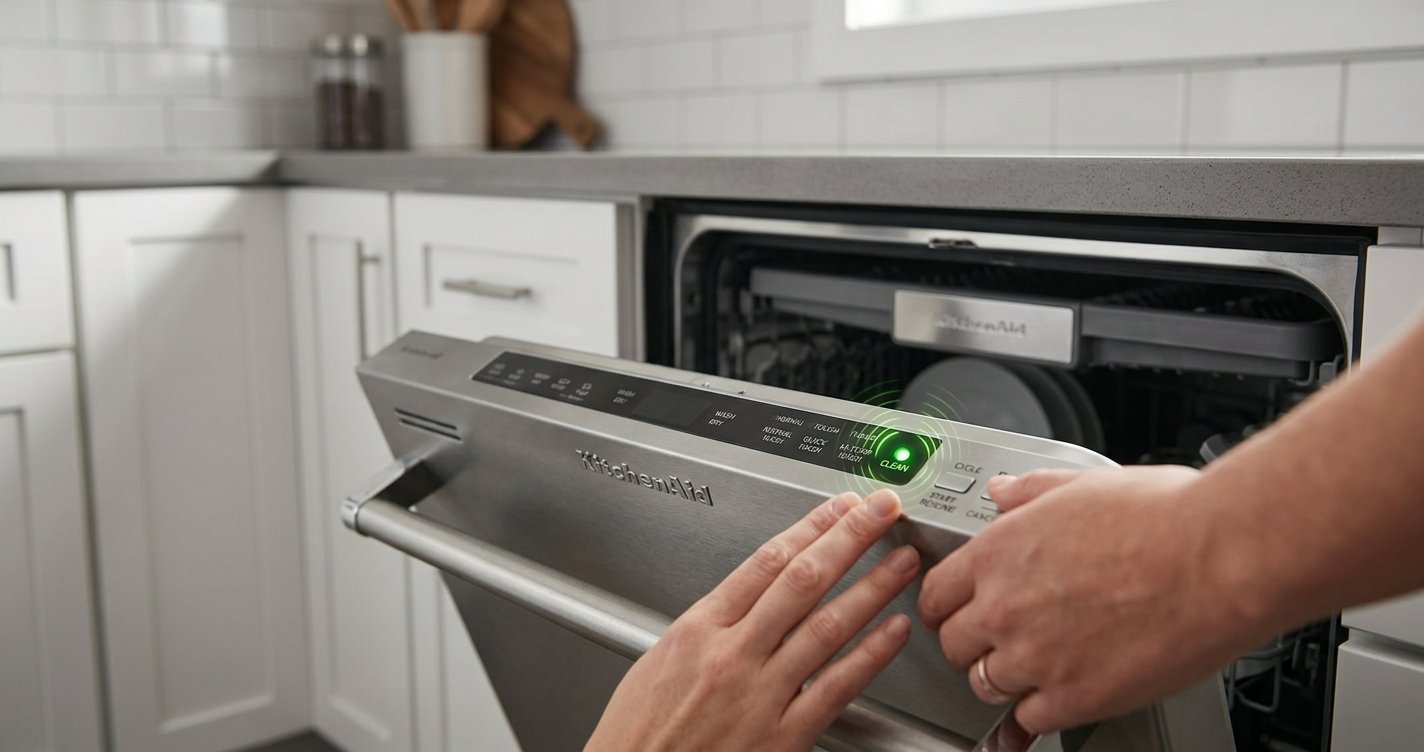
Some KitchenAid troubleshooting instructions specifically recommend checking the dishwasher’s overfill protection float when the Clean light is flashing. The float should be able to move freely up and down and should not be obstructed by food debris or other objects.
If you find an obstruction, remove it carefully and check whether the dishwasher returns to normal operation.
Check the Water Supply
A dishwasher that cannot fill correctly may also stop operating normally. Check that the dishwasher’s water supply is turned on and that the water inlet area isn’t obstructed.
KitchenAid also recommends checking the overfill protection float and other water-flow components when a dishwasher isn’t filling properly.
What If the Clean Light Is Still Blinking After a Reset?
If the light starts blinking again immediately after resetting the dishwasher, don’t repeatedly reset it without investigating the cause.
Pay particular attention to the exact flashing pattern. Different F-E codes can point toward different systems. For example, KitchenAid documents F4E2 as a potential heating-system issue and F6E1 as a possible user-interface/main-control issue.
If the same error returns after a reset, KitchenAid recommends arranging service for applicable error codes.
When Should You Call a Technician?
- The Clean light continues flashing after a proper reset.
- The dishwasher will not start.
- The same error-code sequence repeatedly returns.
- The dishwasher is not heating or completing cycles.
- There is a suspected electrical, wiring, or control-board problem.
- You would need to remove electrical components to continue troubleshooting.
KitchenAid advises referring to the model-specific owner’s manual, particularly for electrical or mechanical problems.
Frequently Asked Questions
Why is my KitchenAid dishwasher Clean light blinking?
A blinking Clean light can indicate an interrupted cycle or an error condition. On many models, the flashing sequence communicates an F-E error code.
How do I reset a KitchenAid dishwasher with a blinking Clean light?
Cancel the cycle if necessary, disconnect power, wait at least 30 seconds, restore power, and then select a new cycle. KitchenAid’s current general guidance recommends waiting at least one minute during a full control reset.
Should I keep using the dishwasher if the Clean light is blinking?
If the dishwasher is operating normally and the light was caused by an interrupted cycle, following the model’s resume procedure may resolve it. If the dishwasher won’t run or the light repeatedly returns, identify the error code and consult the model-specific documentation or arrange service.
Does every KitchenAid dishwasher use the same blinking-code system?
No. The exact codes and troubleshooting procedures can vary by model. KitchenAid recommends using the owner’s manual for the specific dishwasher.
Final Thoughts
A KitchenAid dishwasher Clean light blinking is usually a signal that deserves troubleshooting rather than something to ignore. Start by checking whether the cycle was interrupted, make sure the door and overfill float are unobstructed, and perform a control reset. If the Clean light continues flashing, carefully count the pattern and identify the corresponding error code.