Most Bosch dishwasher pump problems come from food debris, glass slivers, or grease trapped around the impeller — not a broken motor. You can usually fix it in 15–20 minutes: unplug the dishwasher, remove the bottom rack and filter, pop off the small plastic pump cover, clear out any debris by hand, then reassemble. No special tools are required for most models, though some use a Torx screw instead of a snap-lock cover.
Below is the full step-by-step process, plus how to tell when it’s a simple clean versus a sign the pump itself needs replacing.
Read More: Do Dishwashers Use a Lot of Electricity? (Cost & Savings Guide)
Table of contents
Why Does the Bosch Dishwasher Pump Get Clogged?
The pump sits at the bottom of the tub and does two jobs: it forces water up into the spray arms during the wash, and it pushes wastewater out through the drain hose afterward. Everything that washes off your dishes — food particles, grease, small bones, broken glass, produce stickers — passes through the filter first, but fine debris and anything that slips past the mesh can lodge in the pump’s impeller (the small fan-like wheel inside).
Over time this buildup causes:
- Standing water left in the tub after a cycle
- A loud humming or grinding noise during drain
- Dishes coming out gritty or not fully clean
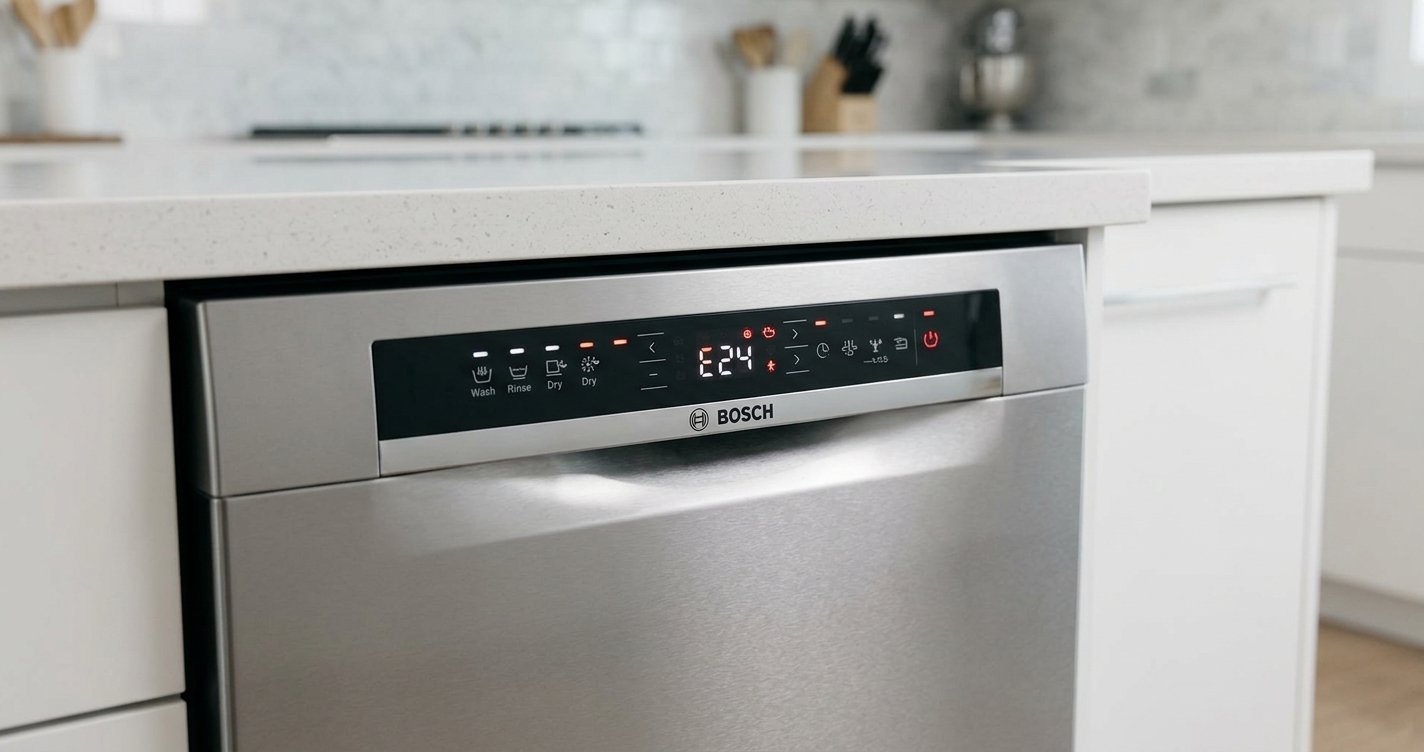
- Error codes related to drainage on the display
Regular filter cleaning greatly reduces how often the pump itself needs attention — but the pump still deserves a check every few months, especially if you notice slow draining.
What You’ll Need
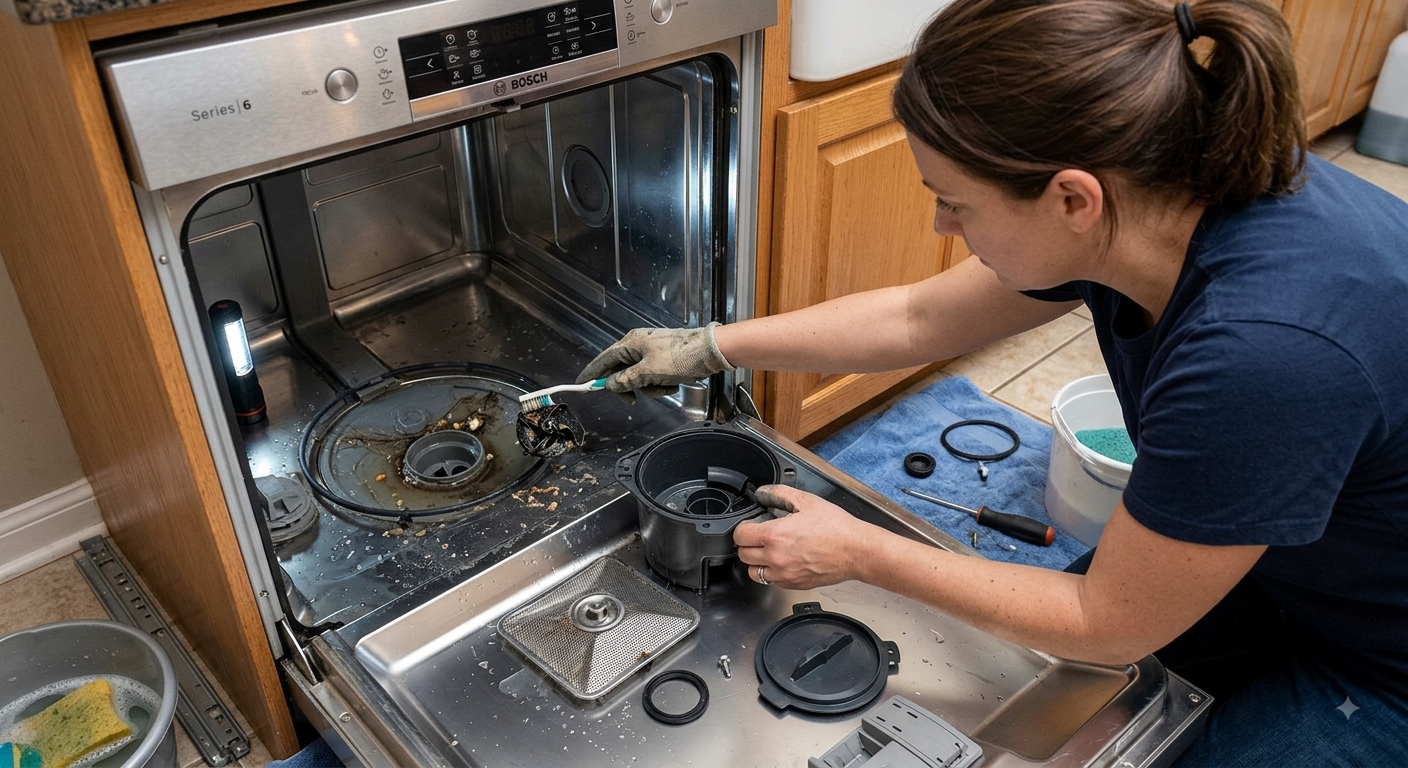
- A soft brush (an old toothbrush works well)
- A small flat tool (a spoon handle or plastic pry tool) for models with a snap-on cover
- A Torx screwdriver (some models secure the cover with a screw instead of clips)
- Dish soap and warm water
- A sponge or cloth for standing water
- Protective gloves — this step matters, since broken glass is a common cause of clogs
Step-by-Step: How to Clean the Bosch Dishwasher Pump
1. Unplug the dishwasher.
Always disconnect power at the outlet (or shut off the breaker) before opening the sump area. Never work on the pump with the unit plugged in, even if the door is closed.
2. Remove the bottom rack.
This gives you clear access to the tub floor, where the filter and pump cover are located.
3. Take out the filter assembly.
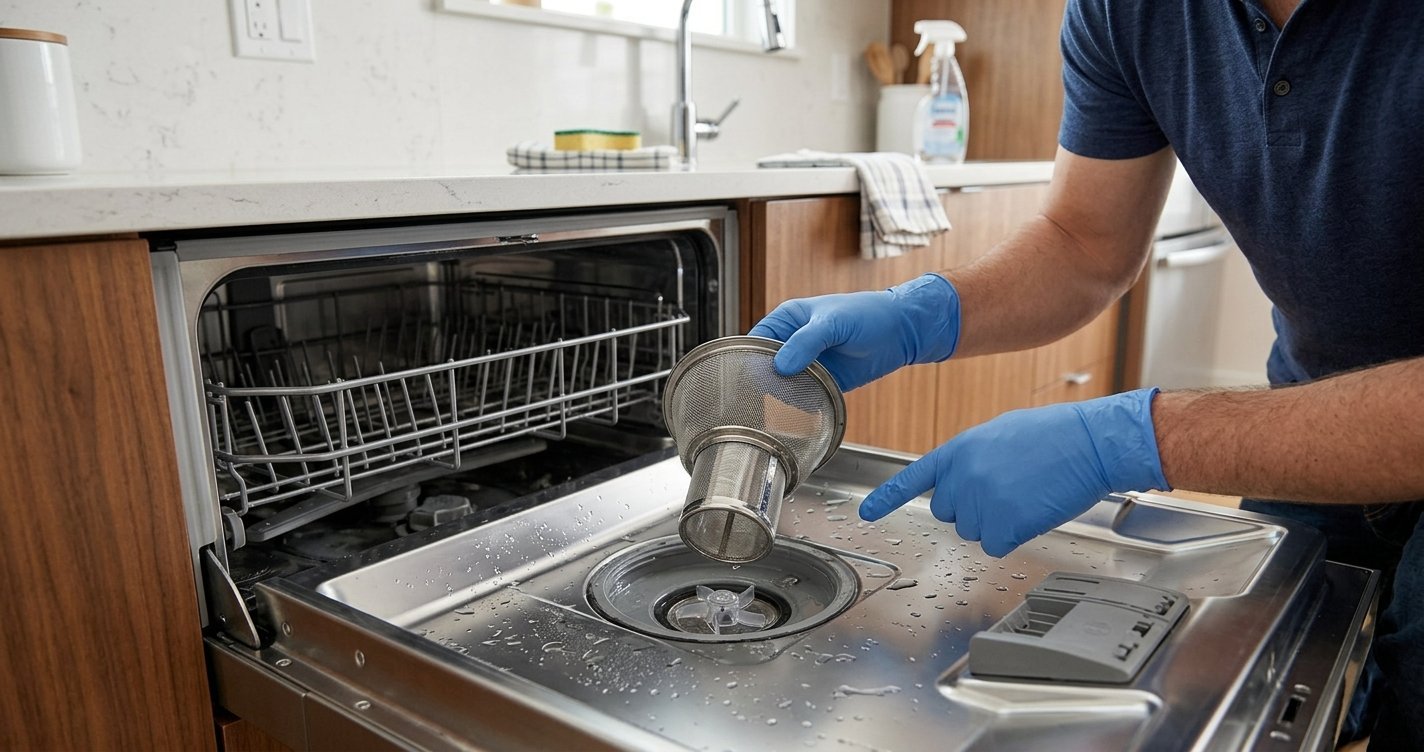
Twist the cylindrical filter counter-clockwise (usually about a quarter turn) and lift it straight out. Most Bosch filters separate into two or three pieces — a coarse outer cylinder, a fine mesh insert, and sometimes a flat screen underneath. Rinse each piece under hot water and scrub gently with a soft brush to remove grease and trapped particles.
4. Soak up any standing water.
Use a sponge or cloth to clear water pooled around the filter opening so you can see the pump cover clearly.
5. Remove the pump cover.
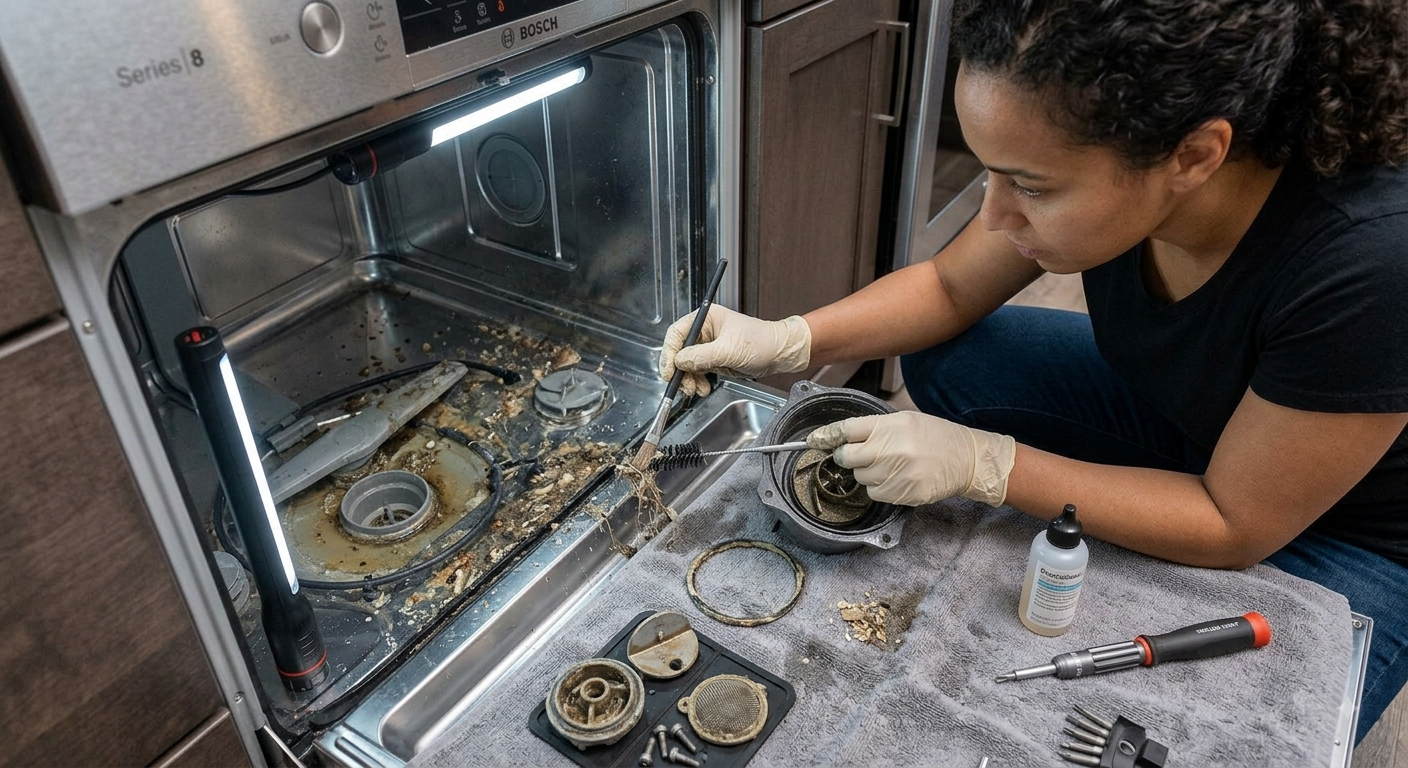
The cover is a small plastic disc located directly under where the filter sat. On most models it lifts out with a firm, careful pull, sometimes with the help of a spoon handle to lever it up. Some models instead use a Torx screw — check your owner’s manual if it doesn’t budge by hand, rather than forcing it.
6. Inspect and clear the impeller.
With gloves on, look into the pump chamber and check the impeller (the small fan blade) for anything wedged against it — glass shards, fruit pits, popcorn kernels, or bones are common culprits. Gently remove debris by hand. The impeller should spin freely when nudged; if it feels stiff or doesn’t move at all, that can point to a mechanical problem rather than a simple clog.
7. Wipe down the sump area.
Use a damp cloth to clean around the cover opening before you reassemble, so no loose debris falls back in.
8. Reinstall the pump cover.
Press it firmly back into place until you feel or hear it click or lock into position — an improperly seated cover is a common cause of leaks afterward.
9. Reinstall the filter.
Line up the arrows on the filter housing with the base, then twist clockwise to lock it in.
10. Run a test cycle. R
eplace the bottom rack, plug the dishwasher back in, and run the shortest wash cycle to confirm it drains properly and there’s no unusual noise.
My Bosch Dishwasher Still Isn’t Draining — What Now?
If cleaning the filter and pump doesn’t solve it, work through these before assuming the pump has failed:
- Check the drain hose for kinks. A twisted or pinched hose under the sink can block drainage even with a perfectly clean pump. Straighten it and feel along its length for blockages.
- Check the garbage disposal connection. If your dishwasher drains through a garbage disposal, a knockout plug that was never removed during installation will block drainage completely.
- Try a drain cycle reset. On many Bosch models, holding the Start button for a few seconds and closing the door will force the pump to run for about a minute, which can clear minor airlocks.
- Look for a door-lock/standing-water error. Some Bosch models won’t unlock the door if they detect water still in the tub — this can look like a “stuck” dishwasher rather than a drainage fault. Running the manual drain reset often resolves it.
If water is still standing after all of this, or the pump hums without moving water, the motor or impeller itself may be damaged.
When to Call a Repair Technician
Cleaning out debris solves the large majority of pump-related problems. Consider calling a certified technician if:
- The pump makes a loud grinding or buzzing noise but no water moves
- The impeller doesn’t spin at all, even after clearing visible debris
- You’ve cleaned the filter, pump, and hose, and the dishwasher still won’t drain
- You see burning smells or the dishwasher trips a breaker
- The pump cover won’t seat properly no matter how it’s reinstalled
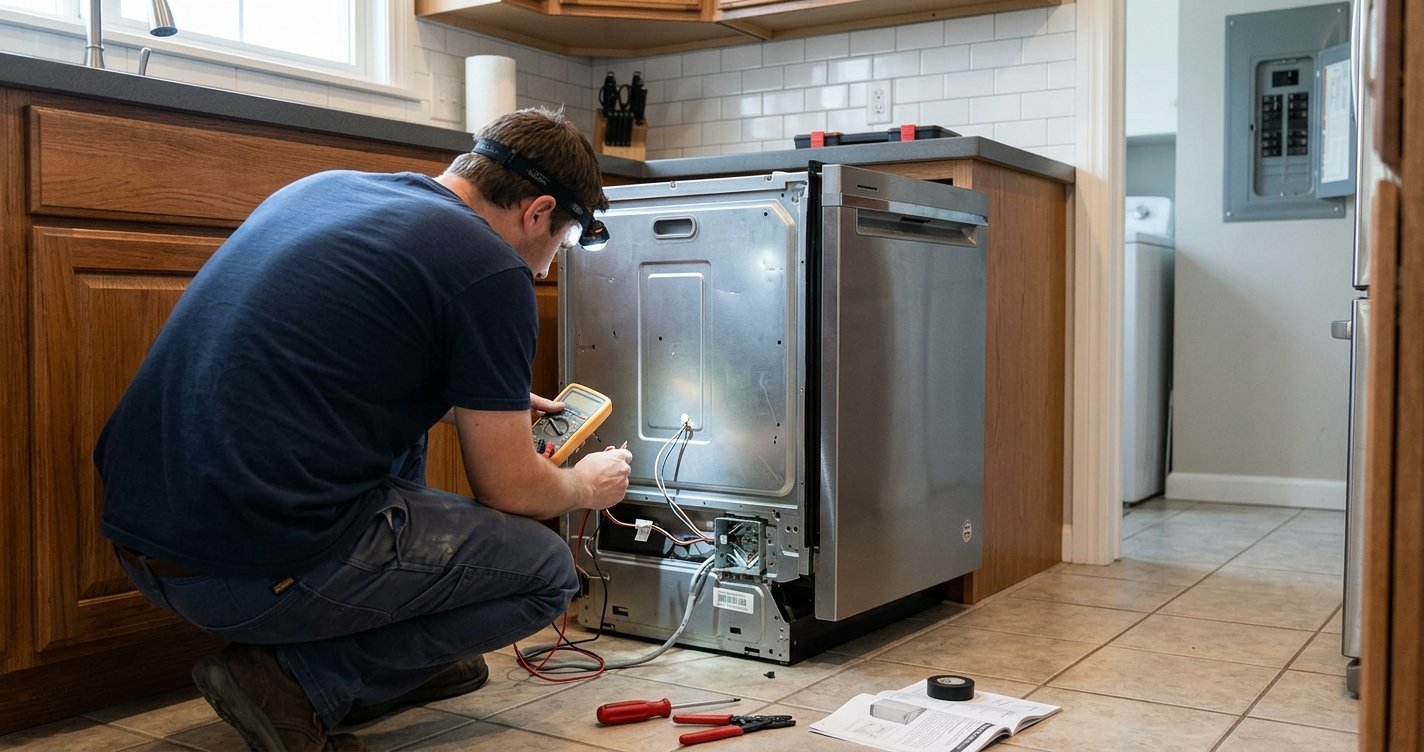
Drain pump replacement is a fairly quick, routine repair for a technician — usually well under an hour — since the pump is held in place by simple clips or screws. It’s generally not a task worth attempting yourself unless you’re comfortable with basic appliance disassembly, since it involves disconnecting hoses and, on some models, electrical connectors.
Frequently Asked Questions
How do I know if my Bosch dishwasher pump is clogged?
The most common signs are water left standing at the bottom of the tub after a cycle, a loud humming noise during draining, and dishes coming out with food residue or a gritty film.
Do I need to remove the whole dishwasher to clean the pump?
No. On nearly all Bosch models, the pump is accessible from inside the tub after removing the bottom rack and filter — you don’t need to pull the unit out of the cabinet.
Is it safe to clean the dishwasher pump myself?
Yes, as long as the dishwasher is fully unplugged first and you wear gloves, since broken glass is a common cause of clogs. The process doesn’t require special tools on most models.
How often should I clean my Bosch dishwasher pump?
Cleaning the filter every 2–4 weeks and checking the pump every few months is enough for most households. Homes that frequently run dishwashers without pre-scraping plates may need to check more often.
Why does my dishwasher hum but not drain?
A humming noise with no drainage usually means the pump motor is running but the impeller is jammed or blocked — this is one of the clearest signs to check for debris before assuming the motor has failed.
Can a clogged pump damage other parts of the dishwasher?
Yes. Ignoring a clogged pump for too long can strain the motor and, in some cases, lead to leaks or the need for a full pump replacement, so it’s worth addressing as soon as drainage issues appear.
The Bottom Line
Most Bosch dishwasher pump issues are a simple debris clog, not a broken machine. Unplugging the unit, pulling the filter, popping off the pump cover, and clearing out trapped debris resolves the problem in the majority of cases — no professional visit required. If the impeller won’t spin freely or the noise continues after a thorough cleaning, that’s your signal to stop troubleshooting and call in a technician rather than risk further damage.