Table of contents
Stainless Steel vs Copper Cookware
Copper conducts heat roughly 25 times better than stainless steel, heating faster and more evenly with instant temperature response — but it costs more, needs regular maintenance, and isn’t induction-compatible unless lined with a magnetic base. Stainless steel is more durable, dishwasher-safe, and works on induction cooktops, but heats more slowly and doesn’t respond to temperature changes as quickly. Choose copper for precision cooking and choose stainless steel for everyday durability and easy care.
This comparison comes down to a genuine trade-off: cooking performance versus practicality. Neither material is “better” outright — the right choice depends on how often you cook, what you cook, and how much maintenance you’re willing to do. This guide breaks down exactly where each one wins.
Read More: Stainless Steel vs Nonstick Cookware: Which Wins?
Core Concepts: What Actually Separates Stainless Steel and Copper
- Thermal conductivity — copper has a thermal conductivity of about 401 W/m·K compared to stainless steel’s roughly 16 W/m·K, which is the core reason copper heats and cools so much faster
- Induction compatibility — pure copper and pure stainless steel don’t reliably work on induction; most copper cookware needs a magnetic stainless lining, and most stainless steel cookware already includes a magnetic layer by design
- Reactivity with food — copper reacts with acidic foods and must be lined (usually with tin or stainless steel) to be food-safe, while stainless steel doesn’t react with food at all
- Maintenance load — copper needs regular polishing to prevent tarnish and shouldn’t go in the dishwasher, while stainless steel is dishwasher-safe and far more forgiving
- Hybrid construction exists — many premium stainless steel lines add a copper or aluminum core sandwiched between steel layers, aiming to combine copper’s heat conduction with stainless steel’s durability and easy care
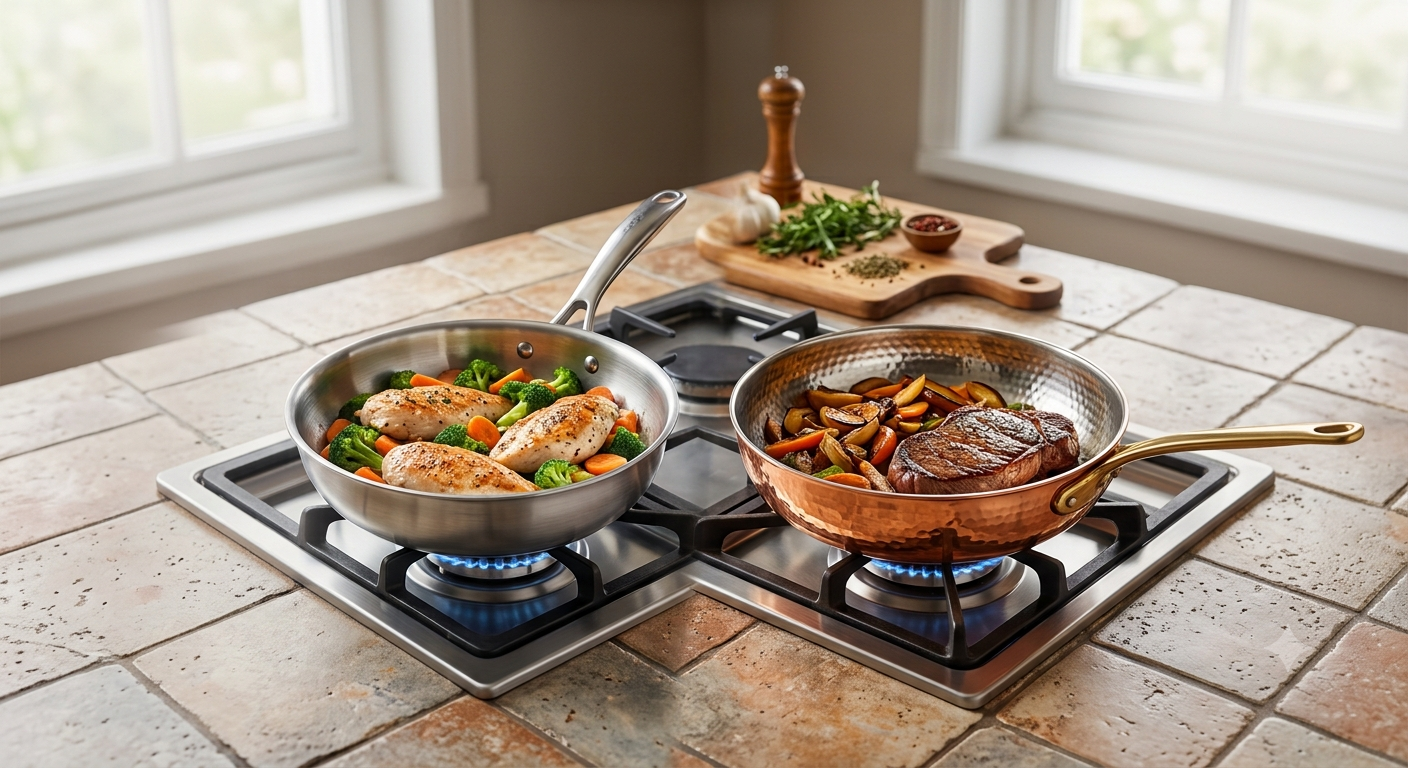
Stainless Steel vs Copper Cookware — Comparison Table
$ – $$
| Factor | Stainless Steel | Copper |
| Heat conductivity | Lower (~16 W/m·K) | Much higher (~401 W/m·K) |
| Heating speed | Slower, more gradual | Very fast |
| Temperature responsiveness | Holds heat, slower to adjust | Reacts almost instantly |
| Induction compatible | Yes, typically | Only if lined with a magnetic base |
| Maintenance | Low — dishwasher-safe | Hand wash, regular polishing |
| Reacts with food | No | Yes, unless lined |
| Durability | Very high, resists dents and rust | Softer metal can dent |
| Typical lifespan | 25–40 years with care | Generations, if retained when needed |
| Price range | $ – $$$ | |
| Best for | Everyday cooking, searing, durability | Precision sauces, professional-style heat control |
When Stainless Steel Wins
Stainless steel is the practical everyday choice for most home kitchens. It’s more durable, easier to maintain, works on induction, and is typically less expensive than copper, which is why it remains the default in most professional and home kitchens alike. Many higher-end stainless lines add a copper or aluminum core between the steel layers specifically to close the heat-conductivity gap without sacrificing durability.
Best for: Everyday cooking, searing, browning, and anyone who wants low-maintenance cookware that lasts decades — matches best stainless steel cookware for everyday use and stainless steel vs copper durability.
When Copper Wins
Copper is the choice for cooks who want precise, fast heat control. It heats up quickly and evenly, allowing for the kind of precise temperature control needed for delicate sauces, candy-making, and dishes where seconds matter. The trade-off is that this same responsiveness leaves less room for error — turn the heat too high on copper, and a dish can go from perfect to burnt quickly.
Best for: Cooks who want restaurant-level heat control and don’t mind extra maintenance — matches best copper cookware for sauces and copper cookware heat control.
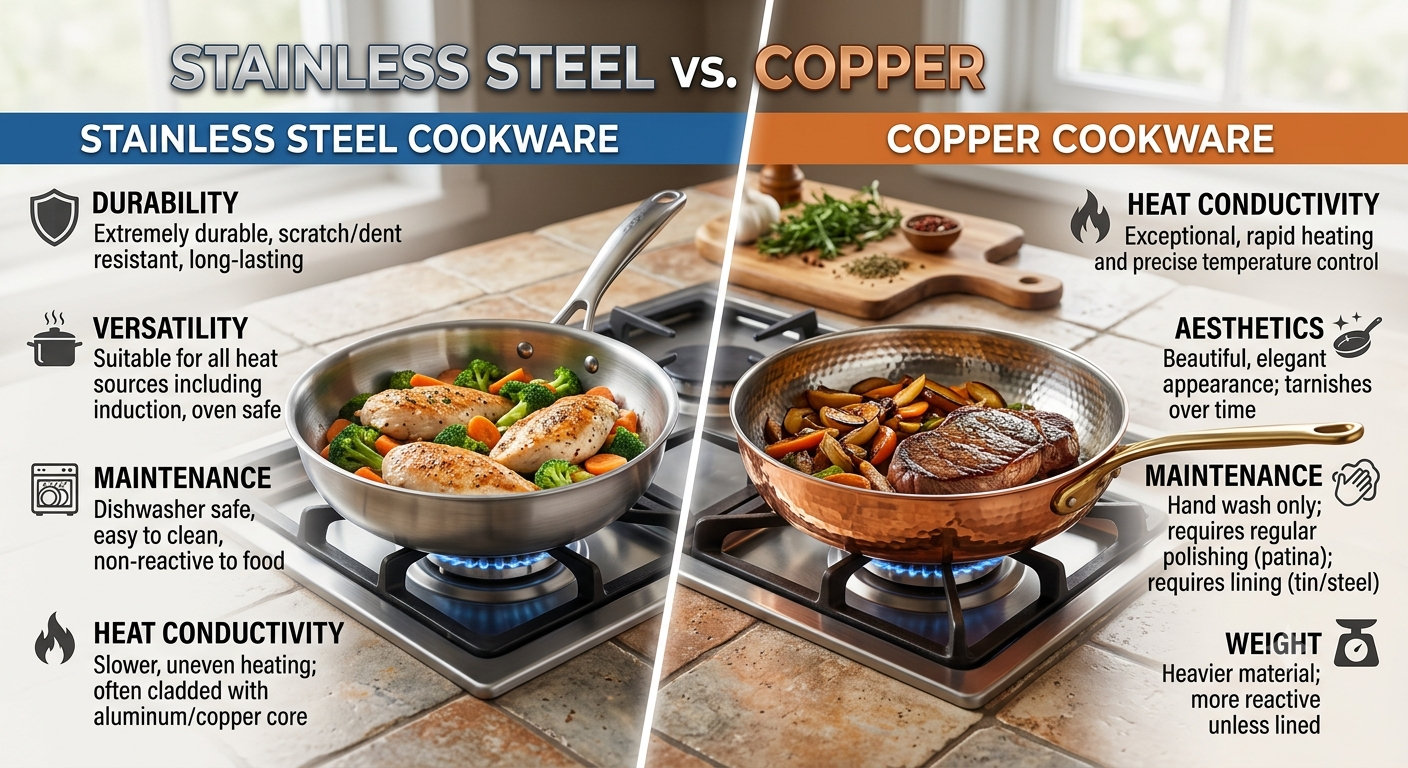
How to Choose Between Stainless Steel and Copper Cookware
- If you want low maintenance and induction compatibility: stainless steel
- If you want the fastest, most precise heat control: copper
- If budget is the top priority: stainless steel
- If you cook delicate sauces or candy regularly, copper, or a copper-core stainless hybrid
- If you want both without the trade-offs, look for tri-ply or 5-ply stainless steel with a copper or aluminum core
People Also Ask
Is copper cookware better than stainless steel?
Neither is universally better — copper wins on heat conductivity and precision, while stainless steel wins on durability, maintenance, and price. The right choice depends on your cooking style.
Why isn’t copper cookware induction-compatible?
Induction cooktops require a magnetic base, and pure copper isn’t magnetic — most copper cookware needs a stainless steel lining or base layer to work on induction.
Does copper cookware need to be relined?
Yes, eventually. Copper cookware is typically lined with tin or stainless steel because unlined copper can react with acidic foods; the lining can wear over time and needs replacing (retinning) to stay food-safe.
Is stainless steel cookware as good as copper for cooking?
For most everyday cooking, yes — stainless steel holds heat well and distributes it evenly, especially when layered with aluminum, making it reliable for consistent results without copper’s higher maintenance.
Which is more expensive, copper or stainless steel cookware?
Copper cookware is generally more expensive than stainless steel, both upfront and over time, due to the cost of the metal itself and the maintenance (like periodic re-tinning) it requires.
Can you use copper and stainless steel cookware together?
Yes — many kitchens mix both, using stainless steel for everyday cooking and durability, and copper for specific tasks like sauces or precision dishes where fast heat response matters most.
Conclusion
Stainless steel and copper aren’t really competing for the same job — stainless steel is built for durability and everyday reliability, while copper is built for speed and precision. Most kitchens don’t need to choose exclusively: a stainless steel set covers daily cooking, and a single copper pan or saucier covers the moments where fast, exact heat control actually matters. If you only want one material, match it to how often you’re willing to hand-wash and polish cookware versus how much precision your cooking style actually demands.