Table of contents
Copper vs Cast Iron: Which Cookware Wins?
Copper heats up fastest and gives the most precise temperature control of any cookware material, but it’s expensive, needs a protective lining, and requires regular polishing. Cast iron retains heat far longer, is much cheaper, and works on induction — but it’s heavy and slower to respond. Choose copper for delicate, technique-driven cooking; choose cast iron for searing, durability, and value.
Copper and cast iron sit at opposite ends of the cookware spectrum: one is prized by professional chefs for split-second heat control, the other for its rugged, budget-friendly heat retention. This guide compares composition, heat performance, safety, maintenance, and cost, with real dish-by-dish decisions and PAA-ready short answers to help you choose.
Read More: Carbon Steel vs Enameled Cast Iron: Which to Buy?
Copper vs Cast Iron: At a Glance
| Factor | Copper | Cast Iron |
| Heat conductivity | ~400 W/mK — the best of any common cookware metal | ~55 W/mK — heats slowly but retains heat excellently |
| Heat response | Instant — heats and cools almost immediately | Slow to heat, very slow to cool |
| Heat retention | Low — loses heat as fast as it gains it | Excellent — stays hot long after the burner is off |
| Cooking surface | Lined with tin or stainless steel (never bare) | Bare seasoned iron or enamel coating |
| Induction compatible | No — copper isn’t ferromagnetic, so most copper cookware won’t work on induction | Yes — iron is naturally magnetic |
| Weight | Moderate to heavy (dense metal, thin walls) | Very heavy (dense metal, thick walls) |
| Maintenance | Polishing to prevent tarnish; re-lining is eventually needed | Seasoning and drying to prevent rust (unless enameled) |
| Price | High | Low |
What Is Copper Cookware?
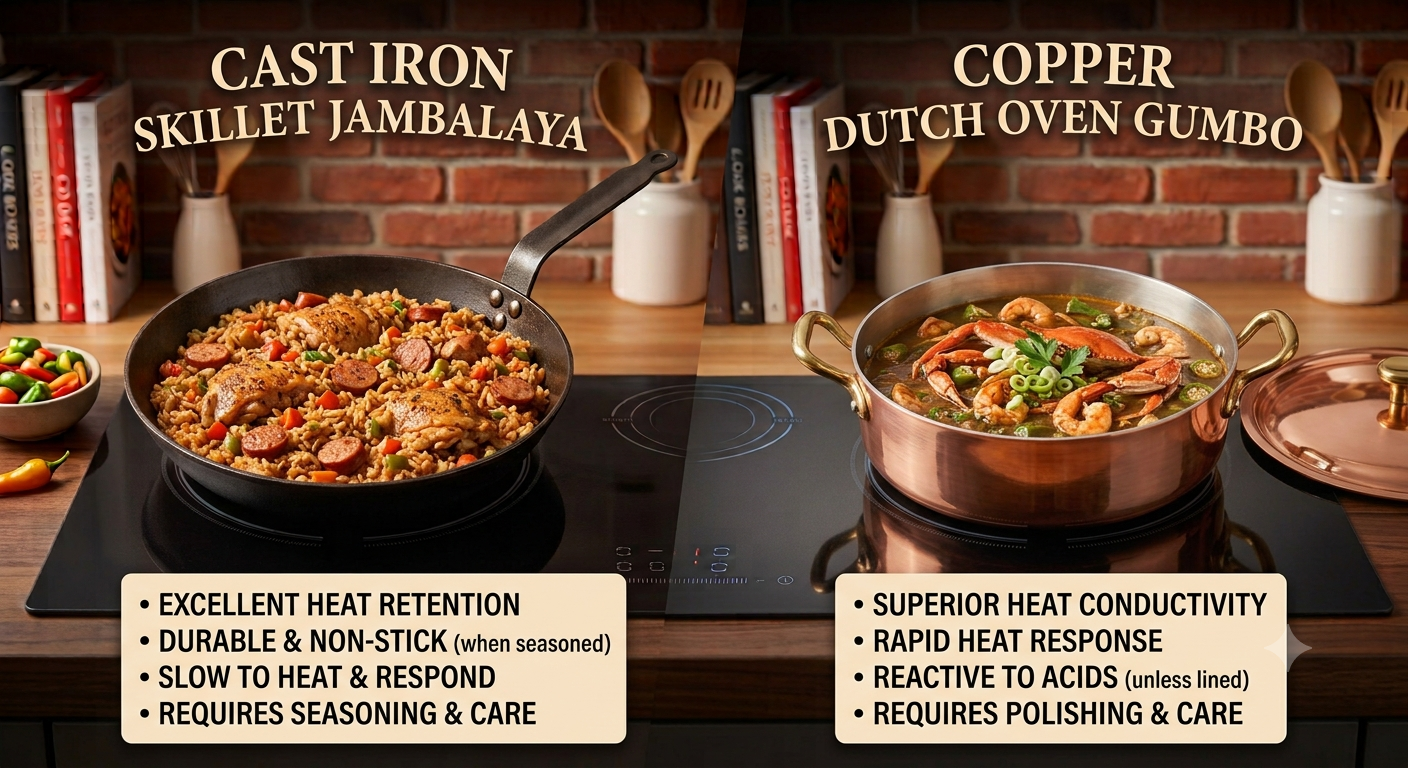
Copper is valued in professional kitchens because it’s one of the best heat conductors of any cookware material, heating quickly and evenly. Because bare copper reacts with food and can leach into acidic dishes, modern copper cookware is lined with a non-reactive metal — usually stainless steel or tin — to create a safe barrier between the copper and your food.
What Is Cast Iron Cookware?
Cast iron is an iron-carbon alloy, roughly 2 to 3 percent carbon to 97 to 98 percent iron, poured into a mold to create thick, dense cookware. Its mass is what makes it hold heat so well, and it’s available bare (seasoned) or enameled for a non-reactive, low-maintenance surface.
Heat Performance: Precision vs. Power
Which heats faster, copper or cast iron?
Copper, by a wide margin. Copper cookware is celebrated for its excellent heat conductivity — it heats up quickly and distributes heat evenly, giving precise temperature control that cast iron can’t match.
Which retains heat longer?
Cast iron. Its thickness and mass give it standout heat retention, making it ideal for searing and slow, steady cooking, while copper loses heat almost as fast as it gains it.
Which gives better temperature control?
Copper. Because it responds instantly to changes in burner heat, cooks can raise or lower the pan’s temperature in real time —a key reason professional chefs favor it for sauces and delicate techniques.
Copper for control and speed, cast iron for power and stability.
Safety & Cooking Surface
Is it safe to cook directly on copper?
No. Bare copper can leach into food, especially acidic dishes, so cooking highly acidic foods like tomatoes, citrus, or vinegar-based recipes in copper with a worn or damaged lining is not recommended. With an intact lining, copper pans are considered safe for all types of recipes.
Tin lining vs. stainless steel lining — which is better?
Tin is naturally slick and great for delicate foods, but soft and prone to wear, while stainless steel is more durable, tolerates higher heat, and needs no re-lining. Tin offers a better cooking surface; stainless steel offers lower maintenance.
Is cast iron safe for cooking?
Yes — bare cast iron can add trace amounts of dietary iron to food, while enameled cast iron is fully non-reactive and safe for acidic dishes.
Maintenance & Care
| Task | Copper | Cast Iron |
| Daily cleaning | Hand wash with mild soap, dry immediately | Hand wash, dry immediately (bare) or wipe clean (enameled) |
| Surface upkeep | Polish to manage tarnish; some prefer the natural patina | Seasoning required for bare cast iron; none for enameled |
| Long-term service | Re-lining (retinning) is needed eventually for tin-lined pans | Re-seasoning as needed; enamel needs no attention |
| Typical restoration cost | Roughly $75–$150 per pan for professional retinning | Minimal — a stovetop re-seasoning costs little beyond oil |
| Rust/tarnish risk | Tarnishes over time (cosmetic only) | Rusts if left wet or unseasoned (bare cast iron only) |
Durability & Lifespan
Which lasts longer?
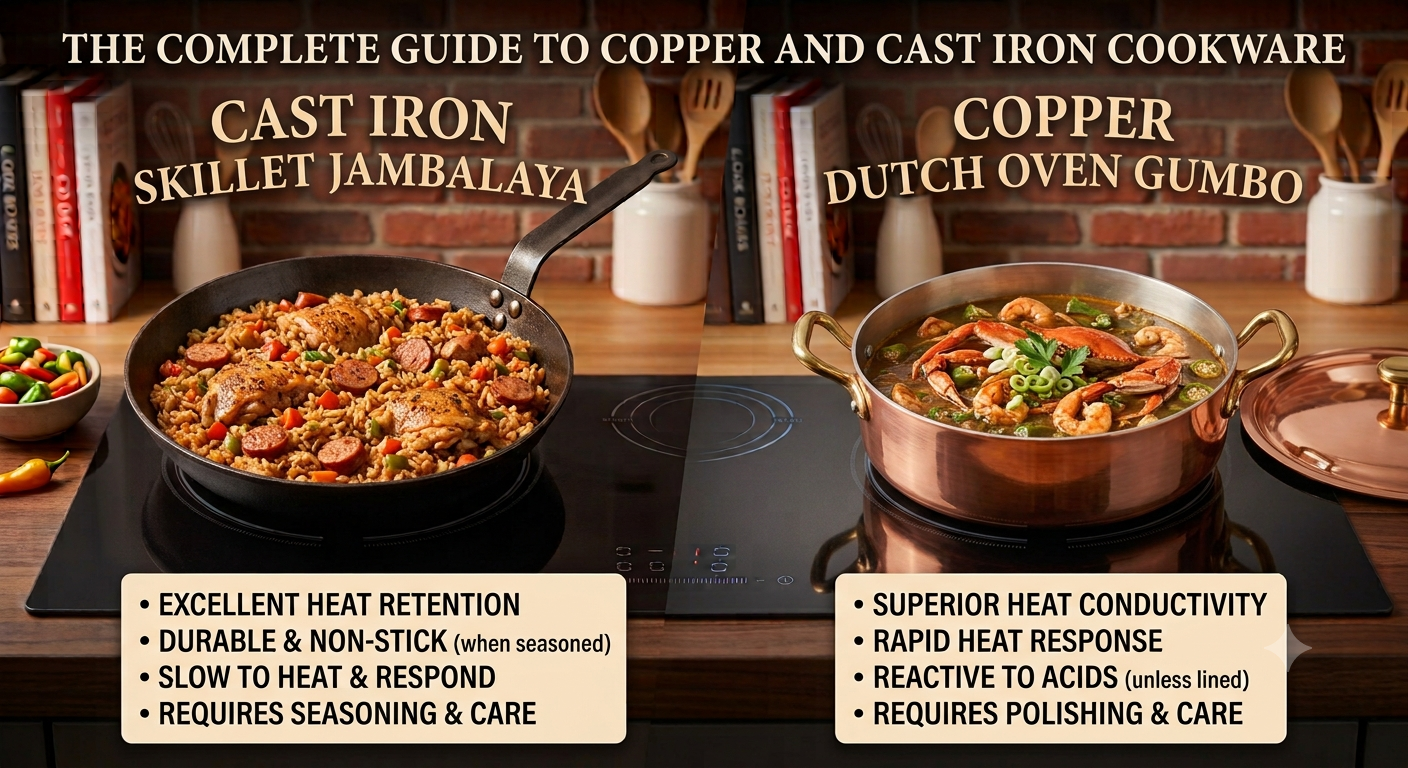
Both can last generations with care. Cast iron is nearly indestructible and can be restored indefinitely, while copper cookware with a quality lining also lasts decades — but the lining itself is a wear item that eventually needs professional attention.
Does copper wear out?
The copper body itself doesn’t wear out, but the interior lining does — tin is a soft metal that will wear out over time and is liable to scratches and dents, meaning it eventually needs re-tinning to stay food-safe.
Cost Comparison
Copper is significantly more expensive than cast iron, both upfront and over its lifetime. Copper metal itself costs more than most other cookware materials, and quality linings add further cost, plus periodic re-tinning fees. Cast iron, by contrast, is one of the most affordable premium cookware materials available and needs no paid maintenance to stay functional.
Real Decisions: Which Pan for Which Task?
- Making a delicate hollandaise or caramel: Copper — instant heat response prevents scorching during precise, fast-changing cooking.
- Searing a steak or getting a crust on a smash burger: Cast iron — its heat retention holds a high, steady temperature through the sear.
- Cooking on an induction stovetop: Cast iron — most copper cookware isn’t induction-compatible since it isn’t ferromagnetic, while cast iron works natively.
- Reducing a wine sauce or tempering chocolate: Copper — rapid, controllable heat changes are essential for these techniques.
- Braising, stewing, or oven-to-stovetop cooking: Cast iron — heavy walls hold a steady low temperature for hours.
- Building a showpiece kitchen or display cookware: Copper — its craftsmanship and appearance have made it a prized, decorative cookware choice for centuries.
Which One Should You Buy?
| If you want… | Choose |
| The fastest, most precise heat control | Copper |
| Maximum heat retention for searing | Cast iron |
| Induction stovetop compatibility | Cast iron |
| The lowest overall cost and maintenance | Cast iron |
| Professional-level sauce and pastry work | Copper |
| A pan that can be restored indefinitely without paid service | Cast iron |
Bottom line: many serious home cooks keep both — a foundation of cast iron for everyday cooking with a few copper “anchor” pieces for tasks that demand precise heat control.
Frequently Asked Questions
Is copper better than cast iron for cooking?
Copper offers faster, more precise heat control; cast iron offers better heat retention and durability at a lower cost. Neither is universally “better” — they suit different techniques.
Can you use copper cookware on an induction stove?
Generally, no, unless it has a magnetic base or induction converter disc — pure copper isn’t ferromagnetic.
Does copper cookware need a lining?
Yes. Bare copper can react with and leach into food, so quality copper cookware is lined with tin or stainless steel.
Is cast iron cheaper than copper?
Yes, considerably. Cast iron is one of the most affordable cookware materials, while copper is among the most expensive due to the material cost and lining.
Which is heavier, copper or cast iron?
Cast iron is generally heavier, since it’s cast as thick, dense metal, while copper cookware uses thinner walls despite copper’s own high density.
Does copper cookware need to be polished?
Not for performance — tarnish is cosmetic — but many owners polish it to maintain its appearance, or let it develop a natural patina instead.
Conclusion
Copper and cast iron represent two different philosophies of cooking. Choose copper if you want the fastest, most precise heat control for sauces, candy-making, or professional technique work, and don’t mind the cost and upkeep. Choose cast iron if you want unmatched heat retention, rock-solid durability, induction compatibility, and low cost with minimal maintenance. Many well-stocked kitchens use cast iron as the everyday workhorse and bring in copper for the handful of dishes where split-second heat control really matters.